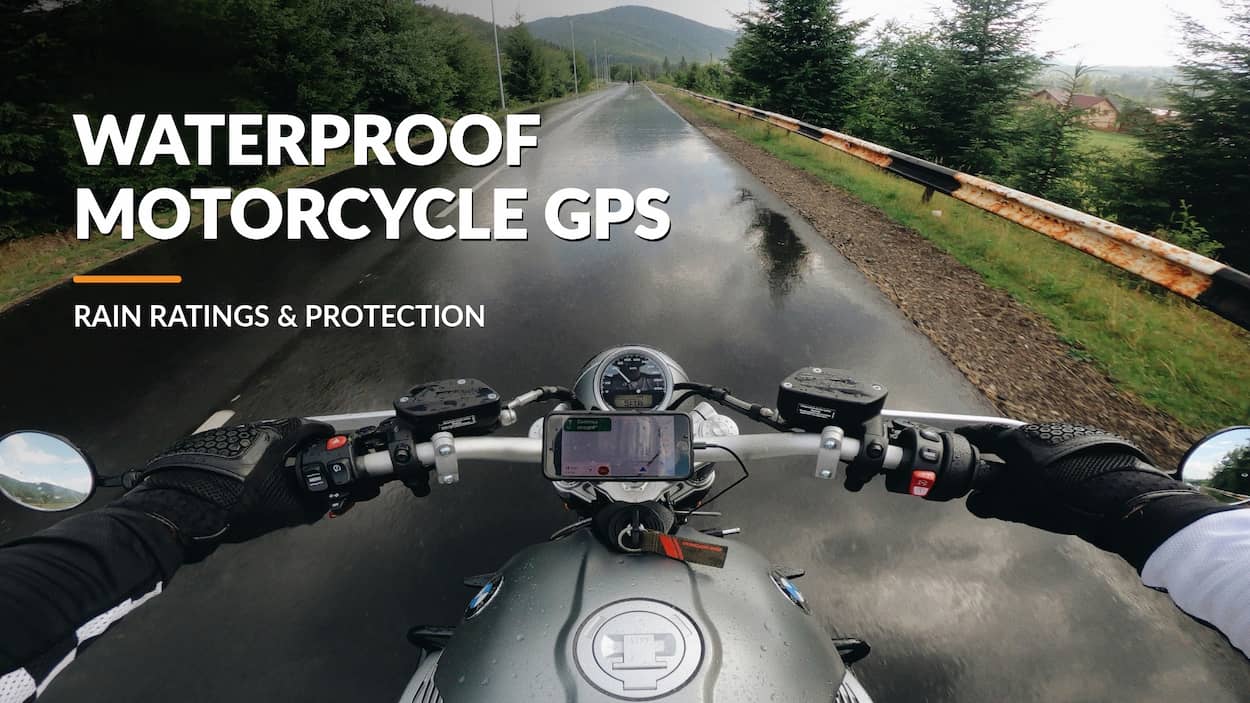
A waterproof motorcycle GPS is designed to handle the rain, road spray and changing weather that come with riding. Unlike an ordinary automotive navigator, a dedicated motorcycle GPS such as the Garmin Zumo XT3 is built to remain exposed to the elements. That does not mean every GPS is equally protected, or that a waterproof rating eliminates every problem caused by heavy rain.
The first question is whether your GPS was designed for motorcycle use. Current Garmin Zumo models have substantial water resistance and normally do not require an additional rain cover. A Garmin Drive or older Nuvi automotive GPS is a different story. Those devices were designed for use inside vehicles, where rain protection is not a normal requirement.
Below we’ll compare the Garmin water ratings, explain why a waterproof touchscreen can still misbehave in rain, and examine protective mounting options for car GPS devices and smartphones. We’ll also cover how to protect the powered GPS cradle when the navigator is removed from the motorcycle.
Quick answer: Garmin Zumo XT, XT2 and XT3 navigators are IPX7 water-resistant and intended for motorcycle use in wet conditions. They do not need a separate waterproof enclosure for ordinary riding in rain. Automotive GPS units generally should not be exposed to rain without suitable protection. Even an IPX7 GPS can experience touchscreen problems during a heavy downpour.
GPS and Rain-Protection Options at a Glance
These four options cover different situations: buying a dedicated waterproof navigator, sheltering an existing car GPS, or protecting a smartphone used for navigation. The cases are not substitutes for the Garmin’s built-in water resistance.
| Product | Best For | Protection / Fit |
|---|---|---|
| Garmin Zumo XT3 6-inch | Touring and larger cockpits | IPX7 water / IP6X dust |
| Garmin Zumo XT3 4.7-inch | Smaller motorcycle cockpits | IPX7 water / IP6X dust |
| DigiCharge GPS Case & Mount | Compatible automotive GPS | Water-resistant enclosure; verify GPS dimensions |
| iMESTOU Enclosed Phone Mount (L) | Smartphone navigation in rain | Advertised IP67; size-specific enclosure |
Are Motorcycle GPS Devices Waterproof?
Many motorcycle GPS devices are commonly described as waterproof, but water-resistant is the more precise term. The distinction matters because no practical water-resistance rating promises unlimited protection against every possible exposure. Depth, pressure, duration, equipment condition and the type of water exposure all play a role.
Purpose-built motorcycle GPS navigators are engineered around conditions that are rarely encountered inside a car. In addition to rain, the device may face dust, road grime, temperature changes, wind and continuous vibration. The case, display, connectors and mounting hardware must accommodate those conditions if the unit is going to remain on a motorcycle during an extended trip.
That is one of the reasons a dedicated motorcycle GPS costs more than a typical automotive model. The additional expense is not just for motorcycle routing and glove-friendly controls. The physical construction and weather protection are important parts of the product.
Do not assume that a device is waterproof simply because a manufacturer calls it a motorcycle navigator. Check the published water-resistance rating for the exact model and follow the manufacturer’s instructions for any connected cables, port covers or accessories.
Understanding IPX7, IP67 and IP68 Waterproof Ratings
Most electronic devices use an Ingress Protection rating, usually shortened to IP, to describe resistance to solid objects and water entering the enclosure. These ratings are defined under the IEC 60529 standard. Understanding the code makes it easier to compare a Garmin Zumo, a smartphone and other motorcycle electronics without relying on vague advertising claims.
The first digit indicates protection against solid objects such as dust. The second digit indicates protection against water. A rating such as IP67 therefore communicates two separate levels of protection, while IPX7 specifies water protection without stating a solid-particle rating in that code.
| Rating | What It Means |
|---|---|
| IPX7 | Protection against temporary immersion in water up to 1 meter for 30 minutes under specified test conditions. No solid-particle rating is stated. |
| IP67 | Dust-tight enclosure combined with the same temporary immersion protection represented by the water digit 7. |
| IP68 | Dust-tight enclosure with protection against immersion beyond the IPX7 conditions, at a depth and duration specified by the manufacturer. |
| IP6X | Dust-tight protection. The X indicates that a water-protection rating is not specified by this particular code. |
What Does IPX7 Mean for Motorcycle Riding?
IPX7 is a useful rating for a motorcycle GPS because a device able to withstand temporary immersion is designed with more water protection than an ordinary indoor electronic display. Garmin rates the Zumo XT series to this standard, making exposure to rain part of the expected operating environment.
There is an important limitation. IPX7 does not certify protection against powerful water jets or pressure washing. Immersion testing and water-jet testing are different procedures, and passing one does not establish compliance with the other.
In practical terms, riding through heavy rain is not the same as directing a pressure washer at the GPS from a short distance. Do not use the immersion rating as permission to clean a navigator with a high-pressure spray.
Does the X Mean the GPS Is Not Dustproof?
No. The X means the particular IP rating does not specify a tested protection level for that category. It does not indicate that dust can enter the device.
For example, Garmin specifies both IPX7 water resistance and IP6X dust protection for the Zumo XT3. These are two separate ratings that describe different properties of the same navigator. The earlier XT2 has a published IPX7 rating, but Garmin does not list a separate IP6X dust rating in its product comparison.
Garmin Zumo XT3, XT2 and XT Waterproof Ratings
Garmin has maintained IPX7 water resistance across several generations of its Zumo motorcycle navigation products. The original XT, the XT2 and the current XT3 all carry that rating. This is good news for owners of older devices because waterproof performance alone is not a reason to replace a functioning XT or XT2.
The XT3 introduces other improvements, including a smaller display option, additional storage and newer ride-data features, but its basic published water-resistance rating remains the same as the preceding generations.
| Garmin Model | Screen | Water Rating | Dust Rating |
|---|---|---|---|
| Zumo XT3 | 4.7″ or 6″ | IPX7 | IP6X |
| Zumo XT2 | 6″ | IPX7 | Not separately specified |
| Zumo XT | 5.5″ | IPX7 | Not separately specified |
Garmin’s official XT3 and XT2 comparison confirms the water ratings. The original XT is also rated IPX7 in its published specifications. For owners of the XT3, the most important point is that both the 4.7-inch and 6-inch versions provide the same published water protection.
Garmin Zumo XT3: Current Motorcycle Navigation
The Zumo XT3 is Garmin’s current dedicated motorcycle GPS platform, introduced in 2026. Both sizes have a high-resolution, glove-friendly touchscreen, motorcycle-specific navigation features and rugged construction intended for outdoor riding. Garmin also lists MIL-STD-810 drop testing and resistance to handlebar vibration.
The XT3 does not need a separate waterproof case for normal use in rain. In fact, placing a large weatherproof enclosure around a device that already has the proper rating can add bulk, interfere with touchscreen operation and complicate mounting. A properly installed XT3 in its intended motorcycle cradle is the more sensible arrangement.
The choice between the two sizes should be based on available mounting space, viewing distance and riding preferences rather than weather protection. The 6-inch model makes sense for a large touring motorcycle, while the 4.7-inch model can be more convenient on a smaller motorcycle with limited space around the instruments.
Garmin Zumo XT3 Motorcycle GPS
Both versions provide IPX7 water resistance and IP6X dust protection. Choose the screen size that suits your motorcycle rather than purchasing an unnecessary waterproof enclosure.
For more details about the navigation features, storage, positioning performance and differences between generations, read our Garmin Zumo XT3 review. This rain-protection guide concentrates on the environmental and installation considerations rather than repeating the complete product review.
What Happens to a Motorcycle GPS in Heavy Rain?
Water entering the electronics is not the only potential problem when a navigator is exposed to heavy rainfall. A touchscreen may interpret falling water droplets as finger inputs. This can cause unwanted menu selections, screen changes or other unexpected behavior even when the GPS enclosure is keeping water out.
Garmin specifically documents this problem for the Zumo XT, XT2 and XT3. In its support guidance, Garmin explains that heavy rainfall can register as touches on the screen and recommends changing the mounting angle or placing the device behind a windshield to reduce direct exposure.
How to Stop Rain from Triggering the Touchscreen
There are several practical options, and the best solution often depends on the motorcycle’s existing windshield and cockpit layout.
- Move the GPS behind the windshield. A windshield or fairing can reduce the amount of direct rainfall reaching the screen without enclosing the navigator.
- Adjust the mounting angle. Changing the screen orientation may reduce the number of droplets striking or collecting on the active touchscreen area.
- Use the screen-lock feature. The Zumo XT2 and XT3 support touchscreen locking, which can prevent water droplets from causing unwanted selections.
- Check visibility before riding. A position that reduces rain exposure should still allow a clear view of the screen without blocking gauges or the road.
On the XT2 and XT3, Garmin says to hold the power button until the on-screen prompt appears, then select Lock Screen. Press the power button again to unlock it. The prompt normally appears after about five seconds, so releasing the button too early may simply put the device into power-saving mode.
That feature is useful during an extended period of heavy rain when the GPS has already calculated the route and there is no need to interact with the screen.
You can read the manufacturer’s instructions in Garmin’s support article on false touchscreen inputs during heavy rain. The problem is a reminder that water resistance and usability during rain are related but separate issues.
Can You Use a Garmin Drive or Car GPS on a Motorcycle in the Rain?
Using an automotive GPS on a motorcycle is possible, but weather protection becomes a much bigger concern. Garmin Drive and older Nuvi units were primarily designed for use inside cars, trucks and other enclosed vehicles. Unlike the Zumo XT series, they generally do not have a published IPX7 rating for motorcycle-style outdoor exposure.
A car GPS may work perfectly well on a motorcycle during dry weather. That does not change its limitations when a sudden rainstorm develops. Water can reach the display edges, controls, power connection and other openings in an enclosure that was never intended to operate in exposed conditions.
For occasional dry-weather riding, a secure handlebar mount may be all that is necessary. For regular touring or routes where rain is likely, I would prefer a dedicated weather-resistant motorcycle GPS. Protecting an automotive navigator is possible, but the protective case, power cable and mounting arrangement become additional things to manage.
There are other differences as well. Automotive GPS screens are not necessarily optimized for use with motorcycle gloves, and their standard suction-cup mounts are unsuitable for exposed motorcycle installations. We cover these compromises in our separate guide to using a Garmin Drive or Nuvi GPS on a motorcycle.
Protective Cases for Car GPS Units and Smartphones
A waterproof motorcycle GPS does not need a second enclosure for normal rainy riding, but a car GPS or smartphone may benefit from additional protection. Two types of products make sense here: a landscape-oriented GPS case with handlebar hardware, and a phone-specific enclosure that also provides a secure motorcycle mounting system.
These products are meant to reduce exposure to rain and road spray. Check the published rating of the exact enclosure and remember that an opening for a charging cable can reduce the protection of the complete installation.
DigiCharge Weather-Resistant Motorcycle GPS Case and Mount
The DigiCharge GPS case and handlebar mounting kit is an option for riders using a compatible automotive navigation device. It is marketed for selected 5-inch car GPS units, including TomTom navigation models, and pairs a protective case with motorcycle or bicycle mounting hardware. It offers a more appropriate arrangement for wet-weather use than placing an unprotected Garmin Drive or TomTom GO directly on the handlebars.
The key limitation is fit. Match the complete width, height and thickness of your particular GPS against the enclosure rather than relying only on its advertised screen size. Check that the case closes correctly, the mount clears the motorcycle controls, and the charging arrangement can be used without defeating the case’s rain protection. Do not assume the enclosure has an IPX7 rating unless one is expressly provided for the exact product.
DigiCharge GPS Case: View on Amazon →
iMESTOU IP67 Enclosed Smartphone Mount
Many riders now use a smartphone as their primary navigation device, which makes a weather-protective phone mount worth covering here. The large iMESTOU enclosed mount offers an advertised IP67 enclosure, a transparent touchscreen panel and an adjustable motorcycle mounting system. Unlike an ordinary open clamp, the case surrounds the phone rather than leaving the display, edges and connectors fully exposed.
This option makes the most sense for riders expecting frequent rain. The large enclosure is designed for compatible phones up to approximately 6.8 inches in screen size, but physical dimensions are the deciding factor. Measure the phone with its normal case if you intend to leave that case installed. A sealed enclosure may also create glare, limit touch sensitivity with gloves and trap heat in hot weather.
For occasional rain, a secure open mount and the phone’s own published water resistance may be more convenient. A phone’s IP rating does not guarantee protection with an ordinary charging cable connected, and a motorcycle vibration dampener is worth considering for phones with delicate camera stabilization mechanisms.
iMESTOU Phone Mount: View on Amazon →
For a closer comparison of sealed enclosures, waterproof ratings and rain-cover alternatives, see our companion site’s guide to waterproof motorcycle phone mounts.
What to Check Before Buying a Protective GPS or Phone Case
Cases and integrated mounts are useful only when the enclosure fits properly and the mounting hardware is suited to motorcycle vibration. Check the entire setup before ordering, including cable access and how quickly you can remove the device.
- Internal dimensions: Measure the device’s full width, height and thickness, not just the screen diagonal.
- Screen visibility: Check the window for glare and distortion, particularly in bright daylight.
- Touchscreen compatibility: A plastic membrane may reduce touch sensitivity, especially when wearing gloves.
- Closure design: Look for a suitable seal, zipper flap or other barrier against rain.
- Power cable entry: An ordinary cable opening can allow water inside the enclosure.
- Mount compatibility: Confirm handlebar diameter, adjustability, steering clearance and device retention.
- Heat management: Sealed cases may trap heat during navigation and charging.
Owners of Garmin Zumo XT, XT2 and XT3 navigators can normally skip these enclosures. A suitable dedicated cradle and a mounting position protected from direct rainfall are the better starting points.
Protecting GPS Power Connections from Rain
The GPS itself may be water-resistant while the power connection remains the weak point in an installation. This is particularly important when a rider uses a car GPS or smartphone that requires a USB charging cable connected to an exposed port.
Do not assume that a phone or GPS retains its normal water-resistance rating with a charging-port cover open or an ordinary cable connected. Similarly, a weather-resistant USB charger does not automatically make the plug, cable and device connection waterproof. The entire installed arrangement needs to be suitable for the conditions in which it will operate.
Dedicated Garmin Zumo models are designed to work with their motorcycle-specific powered mounting hardware. That is one advantage of using the manufacturer’s intended cradle and cable rather than improvising a connection through an exposed USB port.
For any permanent motorcycle GPS installation, pay attention to these details:
- Use the correct powered cradle or manufacturer-approved electrical connection.
- Keep exposed electrical contacts and connectors protected as directed by the manufacturer.
- Route cables away from direct tire spray where practical.
- Secure wiring so it cannot rub against sharp edges or become trapped at full steering lock.
- Use the required fuse protection and avoid unprotected wiring connections.
- Inspect damaged cable insulation, corroded contacts and loose connectors before riding.
For more information about the electrical side of an installation, see our motorcycle USB charger and GPS power guide. It covers dedicated Garmin cradles, USB-C chargers, SAE adapters and the differences between direct-battery and switched-accessory power.
How to Protect an Empty Motorcycle GPS Cradle
Removing a Garmin Zumo at the end of a ride protects the navigator from theft, but it leaves the powered motorcycle cradle behind. The GPS itself may be rated IPX7, yet the electrical contacts on an empty mount still benefit from protection against rain, road grime and corrosion. You generally do not need to disconnect the hardwired cradle each time you park. The better approach is to protect its contacts while it remains installed.
Garmin’s motorcycle mount maintenance guidance recommends several precautions to help extend the life of the mount. Most are simple tasks that take very little time once the motorcycle is properly wired.
Use the Correct Garmin Weather Cap
When the GPS is removed, use the rubber weather cap supplied with the motorcycle cradle, if equipped. These caps protect the exposed electrical contacts from moisture and contamination. On the original Garmin Zumo XT, the rubber cover is attached to the power cable so it remains with the mount when the navigator is removed.
The exact design varies by Garmin model. Do not assume that a cap designed for a Zumo 590 or 595 will fit an XT, XT2 or XT3. Check the cradle and its supplied accessories to determine how the contacts are intended to be covered. Older Garmin weather caps and newer XT-series covers are not universally interchangeable.
Protect the Electrical Contacts from Corrosion
Garmin recommends applying a thin coating of dielectric grease to the exposed contact pins. This helps protect the contact surfaces against moisture and corrosion. Only a small amount is required, and the manufacturer’s instructions should be followed rather than packing the connector with grease.
Inspect the electrical contacts periodically, especially if the motorcycle is parked outside or ridden in wet weather. Dirt, corrosion, damaged pins and loose connections can interfere with power delivery. If the GPS intermittently loses power while mounted, check the cradle contacts and wiring before assuming the problem is inside the navigator.
Use Switched Power When Possible
Another Garmin recommendation is to connect the motorcycle mount to a switched power source. With this arrangement, the cradle receives power when the motorcycle’s ignition or accessory circuit is activated instead of remaining energized continuously while the bike is parked.
This is useful for reducing unnecessary electrical exposure when the device is removed. It also helps prevent an accessory from drawing power while the motorcycle is stored. The proper wiring method depends on the motorcycle, the navigation model and the available accessory circuit. A qualified installer should handle the electrical connection if you are unsure about the wiring.
Keep the Cradle Protected from Direct Rain
Mounting the cradle behind a windshield or fairing can reduce its exposure to rain and road spray. This can be beneficial whether the GPS is attached or removed. Just remember that the location must still provide sufficient clearance for the steering, instruments and surrounding motorcycle components.
If water reaches the connector area, Garmin recommends using compressed or canned air to remove it. Avoid forcing water farther into the connector or using a high-pressure spray. Do not reinstall the navigator onto visibly wet, dirty or damaged contacts.
Are Aftermarket Garmin Cradle Covers Worth Buying?
Some aftermarket covers fit into the empty Zumo mount in place of the GPS, shielding the connection area while giving the cradle a finished appearance. These may be useful if the original rubber cap is missing, damaged or difficult to keep in place.
Compatibility is the main consideration. The Garmin Zumo XT, XT2 and XT3 do not all use interchangeable navigation cradles, and older 590/595 covers use a different design. Buy a cover specifically identified for your mount rather than relying on a broad Garmin compatibility claim.
For most riders, the supplied weather cap, a small amount of dielectric grease and a protected mounting location are sufficient. A replacement cover is an optional convenience rather than a necessary upgrade.
Does Mounting Position Help Keep a Motorcycle GPS Dry?
Even when the navigator is already rated IPX7, choosing a sensible mounting location can make riding in rain more convenient. A GPS positioned behind a windshield may receive less direct rainfall and experience fewer unwanted touchscreen interactions than one mounted completely exposed above the handlebars.
Sheltering the GPS is only one of several considerations. A mount that places the device too low can force the rider to look away from the road, while one placed too high may block the view ahead. There must also be enough clearance for the handlebars to turn fully in both directions without contacting the windshield, tank or surrounding components.
A short, sturdy mounting arm may help keep the navigator compact and reduce movement. On motorcycles with limited handlebar room, a suitable accessory bar, brake/clutch mounting point or fork-stem mount may provide a cleaner location. The correct choice depends on the motorcycle and the device’s cradle.
Our motorcycle GPS mount and installation guide explains the different mounting positions, hardware considerations and clearance checks in more detail. Rain protection is worth considering during installation, but it should never come at the expense of safe control operation or a clear view of the road.
What Should You Do After Riding in Heavy Rain?
Even when a motorcycle GPS is designed for wet weather, a little attention after a rainy ride is sensible. Water droplets, road grime and mineral deposits can accumulate around the screen, cradle and mounting hardware. These deposits may become a nuisance long before the GPS itself experiences any water-related failure.
Wipe the device with a suitable soft cloth and follow the manufacturer’s cleaning instructions. Avoid spraying the navigator with a pressure washer, using aggressive solvents or inserting objects into small openings around the housing. If the device or its connector appears damaged, stop using it until the problem has been evaluated.
If you remove the navigator when parking the motorcycle, check the cradle and its electrical contacts. As covered in the empty motorcycle GPS cradle section above, using the correct weather cap and inspecting the connector helps protect the mount between rides.
For an automotive GPS carried in a protective case, inspect the inside of the case after wet rides. Moisture that enters an enclosure can remain trapped against the electronics. Do not put a wet GPS into a sealed storage case and assume that keeping the outside dry will solve the problem.
Frequently Asked Questions
Can a Garmin Zumo GPS Get Wet?
Yes. Garmin Zumo XT, XT2 and XT3 devices carry IPX7 water-resistance ratings and are designed for motorcycle use in rain. The rating does not mean the navigator is indestructible or suitable for unlimited immersion. Follow Garmin’s operating and maintenance instructions, particularly regarding connectors, cleaning and physical damage.
Does a Garmin Zumo XT3 Need a Waterproof Case?
No additional waterproof enclosure is normally required for riding in rain. Both the 4.7-inch and 6-inch XT3 have IPX7 water protection and a separate IP6X dust rating. Using the appropriate motorcycle cradle and mounting the GPS in a sensible location is usually a better approach than enclosing it in a bulky third-party case.
Should I Cover an Empty Garmin Zumo Cradle?
Yes. When the navigator is removed, cover the exposed electrical contacts using the weather cap designed for that mount. Garmin also recommends a thin coating of dielectric grease, switched power and reduced exposure to rain. A GPS unit’s IPX7 rating does not replace routine care of the empty powered cradle.
Can Heavy Rain Make a Garmin GPS Touchscreen Malfunction?
Yes. Garmin documents that heavy rainfall may be interpreted as touchscreen input by the Zumo XT, XT2 and XT3. The company recommends sheltering or repositioning the navigator to reduce direct rainfall. On the XT2 and XT3, the touchscreen-lock feature can prevent unwanted interaction while navigating.
Is IPX7 Better Than IP67?
Not in terms of the stated water-protection level. Both ratings use the water digit 7, indicating the same category of temporary immersion protection. IP67 additionally specifies a dust-tight rating of 6, while IPX7 does not state a solid-particle protection level. A product’s full set of ratings is more informative than comparing the water digits alone.
Can a Smartphone Be Used for Motorcycle Navigation in the Rain?
Yes, provided the phone and mounting setup are appropriate for the expected weather. Check the smartphone’s published water-resistance rating and avoid assuming it still applies with an exposed charging cable connected. Riders facing frequent heavy rain may prefer an enclosed motorcycle phone case, while an open mount may offer better cooling and touchscreen visibility in fair weather.
Can I Use a Regular Car GPS in the Rain?
Not unless the exact model is rated for the expected exposure or is housed in suitable protective equipment. Most automotive GPS navigators are designed for use inside an enclosed vehicle and should not be treated as weatherproof motorcycle equipment. A protective GPS case can reduce exposure, but its performance depends on the enclosure, cable openings and mounting arrangement.
Should You Remove a Motorcycle GPS During a Thunderstorm?
An IPX7 motorcycle GPS does not automatically need to be removed simply because heavy rain begins. However, severe weather introduces riding hazards that have nothing to do with the electronics. Lightning, poor visibility, strong winds, flooding and slippery roads are reasons to find a safe place to stop. No waterproof rating makes those conditions safe for riding.
Final Thoughts: Keeping a Motorcycle GPS Dry
If you own a Garmin Zumo XT, XT2 or XT3, rain exposure should not be a major concern during normal motorcycle use. These devices are designed for outdoor installation and carry meaningful water-resistance ratings. A suitable mounting position, the correct powered cradle and attention to the manufacturer’s instructions are more useful than wrapping an already protected navigator in another case.
A conventional automotive GPS or smartphone requires a different assessment. The DigiCharge GPS enclosure provides a mounting-and-protection option for compatible car navigators, while the iMESTOU enclosed mount is intended for suitable smartphones. In either case, verify the device dimensions, mounting security and protection around any charging cable before riding in rain.
Before leaving a motorcycle parked outdoors, remember that the navigator and its powered cradle need different types of protection. The GPS can be removed for security, while the cradle contacts should be covered and maintained to help prevent moisture-related problems.
The most important distinction is between a GPS that was built to withstand motorcycle conditions and one that was simply adapted to fit on the handlebars. Choosing the right equipment from the beginning makes rain protection easier to manage.