A motorcycle USB charger is now one of the easiest ways to power navigation gear, phones and other electronics on a bike. But if you use a dedicated motorcycle GPS such as the Garmin zūmo XT3, a proper powered cradle and hardwired connection may still be the better solution.
The good news is that riders have far more power options today than they did when we first wrote this guide. You can use USB-C, an SAE battery connection, a factory accessory circuit or a dedicated GPS wiring harness depending on your motorcycle and the device you want to power.
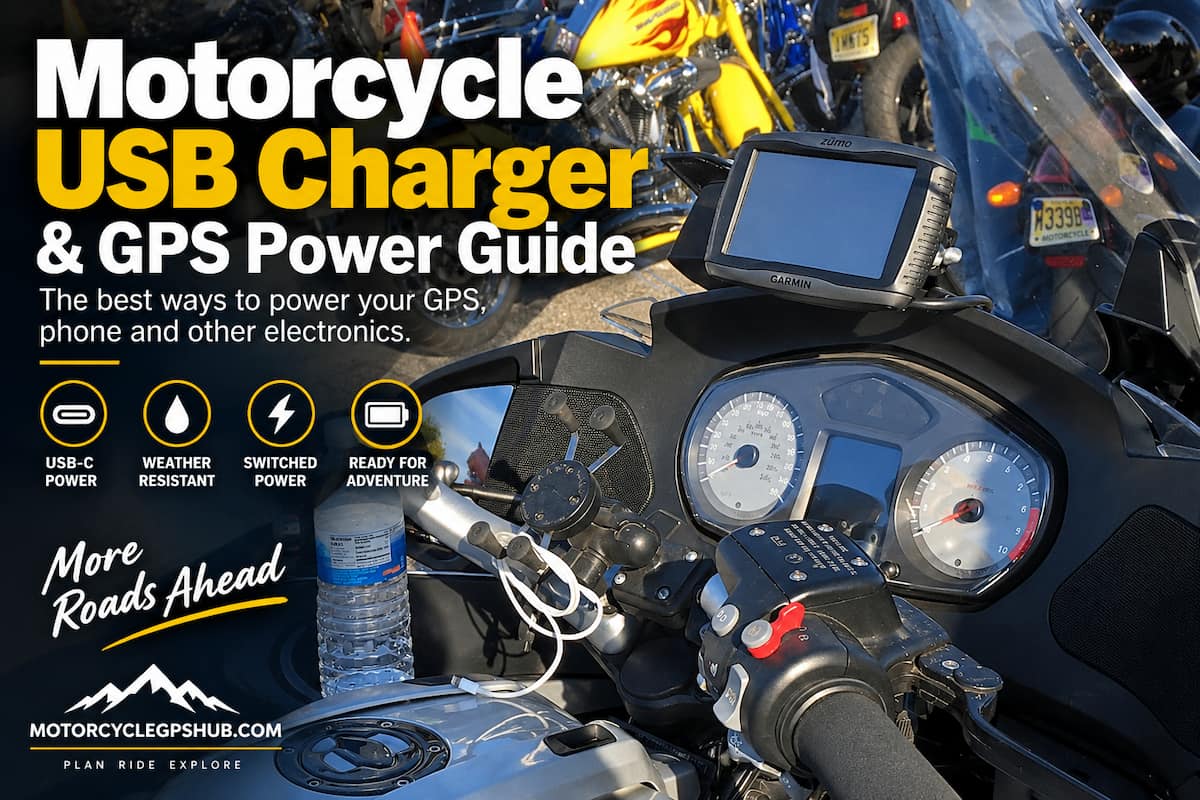
If you still need to decide where the GPS itself will go, start with our guide to mounting a Garmin zūmo or TomTom Rider on a motorcycle. Mount placement and cable routing should really be planned together.
What Is the Best Motorcycle USB Charger Setup?
For most riders, I would divide motorcycle power setups into two groups.
- USB-powered devices: phones, small navigation units, action cameras and many other accessories.
- Dedicated motorcycle GPS units: devices such as the Garmin zūmo XT3 that work best with a powered motorcycle cradle.
If your navigation device charges through USB-C, a weather-resistant motorcycle USB charger is usually the easiest solution.
If your GPS includes a dedicated powered mount, I would normally use that instead.
The important point is that there is no reason to force every device into the same power setup.
Motorcycle USB Charger Options
A motorcycle USB charger can be installed several different ways. The right choice depends on whether you want something permanent, removable or tied into the motorcycle’s ignition.
Handlebar-Mounted USB Chargers
A permanent handlebar-mounted charger is a good choice if you regularly power a phone or USB navigation device.
Look for a charger with:
- USB-C Power Delivery
- Weather-resistant covers
- Proper fuse protection
- A solid handlebar or dashboard mount
- A physical power switch or switched-power connection
I prefer USB-C over older USB-A-only motorcycle chargers because newer phones and navigation electronics increasingly use USB-C.
Just be careful with permanently powered USB adapters. Some contain voltage converters or LED displays that draw a small amount of power even when nothing is plugged in.
SAE-to-USB Motorcycle Chargers
If your motorcycle already has an SAE Battery Tender connection, an SAE-to-USB adapter is one of the simplest ways to add charging capability.
You plug the charger into the existing SAE quick disconnect and gain USB charging without installing another permanent cable.
Battery Tender makes a USB-C adapter designed specifically for this type of motorcycle connection.
Battery Tender SAE Quick Disconnect USB-C Charger
This type of adapter is particularly handy for riders who already use a Battery Tender when the motorcycle is parked.
Battery Tender also offers an adapter combining USB-A, USB-C and a voltage display.
Battery Tender USB + USB-C Adapter With Voltage Display
I like this approach because the adapter can be removed when you do not need it.
Should You Use USB to Power a Motorcycle GPS?
Sometimes, but not always.
A GPS or navigation device designed to run from USB power is a natural fit for a motorcycle USB charger.
A dedicated motorcycle GPS such as the Garmin zūmo XT3 is different. Although the XT3 has a USB-C connection, Garmin provides a powered motorcycle mount specifically for permanent motorcycle use.
The powered cradle gives you a cleaner installation and lets you install or remove the GPS without connecting and disconnecting a USB cable each time.
For that type of GPS, I would use the powered mount and reserve the USB charger for your phone or other accessories.
Garmin zūmo XT3 Motorcycle Power
The current Garmin zūmo XT3 uses a dedicated powered motorcycle mount connected to the motorcycle electrical system.
The installation includes:
- Powered motorcycle cradle
- Red positive power wire
- Black ground wire
- Inline fuse
- Battery connection hardware
- Cable ties for securing the harness
Garmin’s motorcycle power cable for the zūmo XT2 and XT3 is part number 010-13285-03 and uses a 3-amp mini-blade fuse.
If you are buying a current dedicated Garmin motorcycle GPS, the zūmo XT3 is the model I would be wiring for today.
Garmin zūmo XT3 6-Inch Motorcycle GPS
Garmin also offers the XT3 in a smaller 4.7-inch size for riders who want less hardware taking up space around the handlebars or instrument cluster.
Garmin zūmo XT3 4.7-Inch Motorcycle GPS
Switched Power Is Usually My First Choice
If I am installing a permanent GPS cradle or motorcycle USB charger, I generally prefer switched accessory power when the motorcycle provides a convenient connection.
Switched power means the circuit is energized only when the motorcycle ignition or accessory system is on.
Turn off the bike and the charger or GPS wiring shuts down with it.
This helps avoid slow battery drain from devices that remain electrically connected while the motorcycle is parked.
Many motorcycles have a factory accessory connector or auxiliary fuse location intended for accessories.
Check your owner’s manual, service information or dealer before tapping into wiring.
This is especially important on newer motorcycles with CAN bus electronics or electronically controlled accessory circuits.
Direct Battery Wiring
Direct battery wiring remains another perfectly usable method, especially for a dedicated GPS mount.
The basic arrangement is simple:
- Route the GPS or charger power cable toward the battery.
- Connect the positive lead to the proper positive terminal.
- Connect the ground lead to the correct negative or ground point.
- Keep the manufacturer-specified fuse in the circuit.
- Secure the wiring along the motorcycle frame.
The disadvantage is that the circuit remains connected even when the motorcycle is off.
That may not matter on a bike ridden regularly, but it is less ideal on a motorcycle that sits for long periods.
Motorcycle USB Charger vs. Dedicated GPS Wiring
| Power Method | Best For | Main Advantage |
|---|---|---|
| USB-C motorcycle charger | Phones, USB-powered GPS units and accessories | Flexible and works with many devices |
| SAE-to-USB adapter | Bikes already equipped with an SAE battery lead | Very easy to add or remove |
| Dedicated GPS powered mount | Garmin zūmo and similar motorcycle GPS units | Cleanest permanent GPS installation |
| Direct battery wiring | GPS mounts and accessories where switched power is unavailable | Works on almost any motorcycle |
| Switched accessory power | Permanent GPS and USB installations | Automatically shuts off with the bike |
What Should You Look for in a Motorcycle USB Charger?
Not every cheap USB adapter belongs on a motorcycle.
For permanent use, I would look for a few specific features.
USB-C Power Delivery
USB-C PD gives you better compatibility with modern phones and navigation devices than an older low-output USB-A connection.
Weather Protection
The charger should have a protective cover or cap when nothing is plugged in.
Remember that the weather resistance of the charger does not automatically make the USB cable or plugged-in device waterproof.
Proper Fuse Protection
Any permanently wired accessory should have appropriate circuit protection.
If the manufacturer supplies an inline fuse, do not remove it or substitute a larger fuse.
Secure Mounting
Motorcycle vibration is tough on electronics and wiring.
A charger dangling from the handlebars by its wires is not going to last very long.
Switched Power or an On/Off Switch
If the charger connects directly to the battery, I strongly prefer either switched power or a physical power switch.
Do Not Bypass the Fuse
The fuse is there to protect the wiring and equipment.
The Garmin XT2/XT3 motorcycle power harness uses a 3-amp mini-blade fuse.
If a fuse keeps blowing, replacing it with a larger fuse is not the solution.
A repeated fuse failure means something in the wiring or connected equipment needs to be checked.
How to Route Motorcycle GPS and USB Wiring
Good cable routing matters almost as much as the electrical connection.
Before tying everything down permanently, turn the handlebars completely left and right.
Make sure the wire never becomes tight or gets trapped between moving components.
Keep GPS and USB charger wiring away from:
- Exhaust pipes
- Engine heat
- Sharp metal edges
- Steering stops
- Suspension components
- Chains and belts
- Areas where body panels can pinch the cable
Use cable ties or motorcycle wiring clips to secure the cable along the existing harness where practical.
Leave enough slack near the handlebars for normal steering movement, but not enough that the cable can flap around while riding.
Do Not Stuff Extra Wiring in a Saddlebag
The old version of this article suggested placing excess cable in a saddlebag or tank bag.
I would not recommend that now.
A permanent electrical harness should be routed and secured on the motorcycle itself.
Bags get removed, opened, overloaded and moved around, making them a poor location for permanent electrical wiring.
What About TomTom Rider GPS Units?
Many TomTom Rider 500 and Rider 550 GPS units are still in use, and the same basic wiring principles apply.
Use the proper motorcycle power cable or cradle, retain the specified fuse and route the wiring safely.
I would not substitute random automotive mounts or third-party wiring simply because the connector appears to fit.
Can a USB Charger Drain a Motorcycle Battery?
Yes, depending on the charger.
A basic mechanical connector may draw virtually nothing with no device plugged in, while some USB chargers contain voltage converters, displays or indicator lights that consume power continuously.
This is one reason switched power is attractive.
If the charger turns off when the ignition turns off, battery drain becomes much less of a concern.
My Preferred Setup
If I were setting up a motorcycle today, I would use two separate power arrangements.
For a Garmin zūmo XT3:
- Use the Garmin powered motorcycle cradle.
- Connect it to factory-approved switched accessory power when practical.
- Keep the supplied fuse protection.
For a phone or USB-powered accessory:
- Add a USB-C motorcycle charger.
- Use switched power if installing it permanently.
- Use an SAE-to-USB adapter if the motorcycle already has a convenient Battery Tender lead.
That gives you a clean GPS installation while still providing flexible USB power for everything else.
Final Thoughts
A motorcycle USB charger is now one of the most useful electrical accessories you can add to a bike.
USB-C works well for phones, small navigation devices and other electronics, while an SAE adapter can add charging capability without installing another permanent harness.
For a dedicated Garmin zūmo, however, I still prefer the manufacturer’s powered motorcycle cradle.
The best setup is usually a combination of the two: a properly wired GPS mount for navigation and a separate USB-C charging connection for everything else.
Whichever approach you choose, keep the wiring fused, weather-protected, securely mounted and clear of heat and moving parts.
“`