Using a handheld GPS on a motorcycle can make sense for dual-sport riding, forest roads, backcountry trips and riders who already use the same navigator for hiking. The important question is not whether a handheld can receive a GPS signal while you ride. It is whether its screen, maps, controls, power arrangement and mount are suitable for your motorcycle. Our recommendations draw on 20 years of experience selling and evaluating GPS devices and mounting equipment, supported by product research and technical analysis.
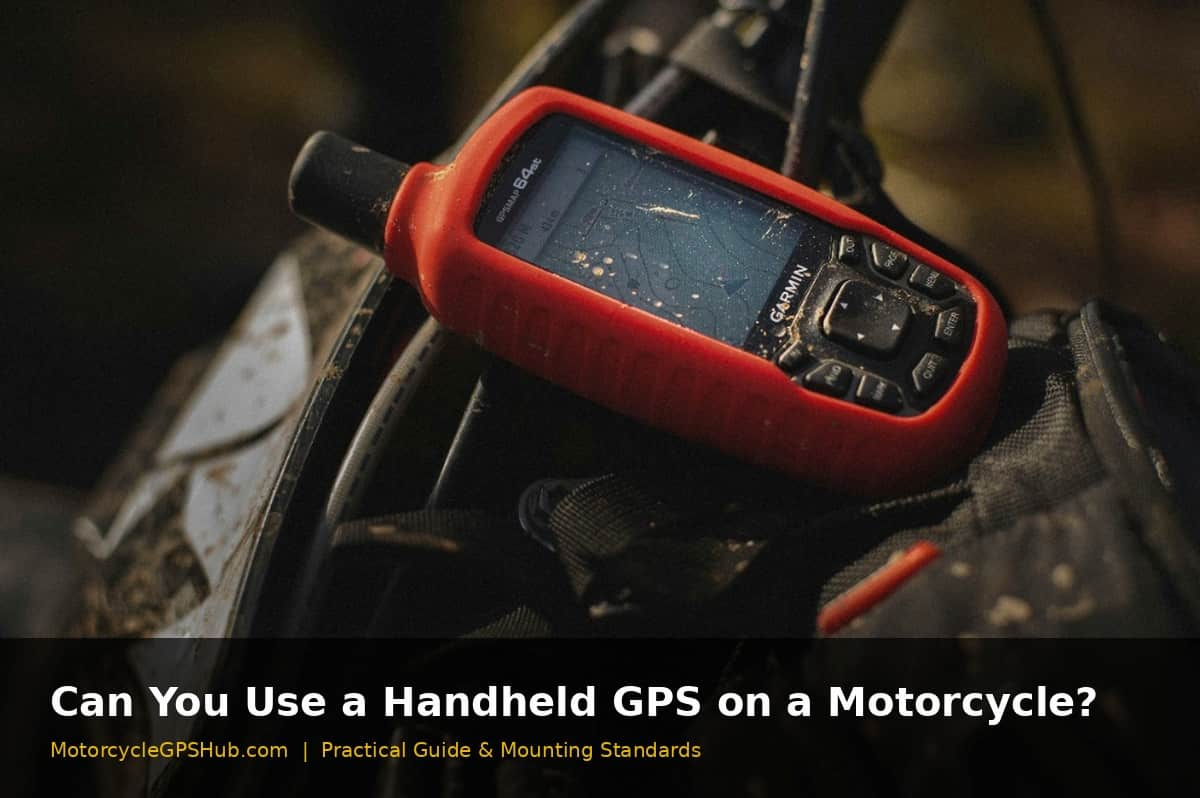
Quick answer: Yes, a handheld GPS can work on a motorcycle, especially for following prepared GPX tracks or using one device for riding and hiking. The 5-inch Garmin Montana 710 family is a strong crossover option, while the compact, button-operated GPSMAP 67 family may suit riders with limited cockpit space. For frequent highway touring, compare a dedicated motorcycle navigator such as the Garmin Zumo XT3 before buying a handheld. Whatever you choose, verify the installed maps and use a secure, model-specific mount.
When a Handheld GPS Makes Sense on a Motorcycle
Handheld GPS units are popular with hikers, hunters and people who navigate away from paved roads. A number of models can also work well on a motorcycle. Three situations make them particularly appealing:
- Dual-sport and off-road routes: A rider following a prepared track may value outdoor mapping, waypoints and buttons or screens suited to field use. A dedicated motorcycle GPS can also follow tracks, so compare the specific navigation modes rather than assuming every Zumo will send you back to pavement.
- One device for more than one activity: A handheld that moves between the motorcycle, backpack and ATV can be more useful than buying separate navigators. The compromise is that a large handheld may feel bulky on foot, while a small one may be harder to read from a riding position.
- Satellite communication: Models such as the Montana 710i and GPSMAP 67i include inReach messaging and interactive SOS when activated with a satellite subscription. For emergency access after a crash, the device needs to remain reachable by the rider. A communicator attached to the motorcycle may be out of reach if rider and bike become separated.
If you mainly ride highways and want easy address entry, route guidance and helmet audio, start with our motorcycle GPS buying guide. A dedicated unit may serve that purpose with fewer compromises.
Handheld GPS vs. Motorcycle GPS: What Changes?
The current Garmin lineup makes the choice less obvious than it was when this article originally featured the Rino and Oregon. The Montana offers a larger touchscreen and vehicle-mounting options; the GPSMAP 67 is compact and button-operated; the Zumo XT3 is designed primarily for motorcycle navigation.
| Feature | Zumo XT3 (6-inch) | Montana 710 / 710i / 760i | GPSMAP 67 / 67i |
|---|---|---|---|
| Primary role | Motorcycle navigator | Large crossover handheld | Compact outdoor handheld |
| Display | 6-inch touchscreen (also offered in 4.7-inch version) | 5-inch glove-friendly touchscreen | 3-inch screen and physical buttons |
| Preloaded maps | Motorcycle-oriented road and outdoor mapping | TopoActive on all three; City Navigator on 710i and 760i only | TopoActive; confirm any additional road maps needed |
| Internal storage / microSD | 64 GB / up to 256 GB (exFAT) | 32 GB / up to 32 GB | 16 GB / up to 32 GB |
| Advertised GPS battery life | Up to 7 hours; up to 5 at full backlight | Up to 24 hours in GPS mode | Up to 180 hours in GPS mode |
| Built-in inReach | No | 710i and 760i only | 67i only |
| Motorcycle mounting | Purpose-built powered motorcycle mounting system | Optional powered motorcycle/ATV kit | Compatible passive cradle and mounting hardware |
Battery figures are manufacturer maximums under specified conditions, not guaranteed runtime with the screen continuously illuminated and navigation in use. Satellite messaging also requires an active subscription on the inReach models.
Four Things to Check Before Mounting a Handheld
1. Screen Readability From the Riding Position
A screen that looks large enough in your hand can be difficult to read once installed beyond your instruments. The Montana’s 5-inch display provides more map space than a GPSMAP 67, but screen size is not the only factor. Map contrast, sunlight, glare, viewing distance and text size all matter.
Before riding, sit on the parked motorcycle wearing your normal helmet and eyewear. Look at a realistic route at the planned mounting position. If you need to lean forward or study the display to identify the next turn, change the position, map detail or device. No particular screen dimension guarantees safe readability for every rider.
2. Touchscreen or Physical Buttons
The Montana uses a glove-friendly touchscreen, which can make entering destinations and panning around a map convenient when stopped. The GPSMAP 67 series uses physical buttons, useful for riders who prefer tactile controls. Either design has drawbacks: small buttons can be awkward with winter gloves, and touchscreens can behave differently when wet. Test controls with your actual riding gloves before depending on them.
3. Weather and Vibration Protection
The Montana and GPSMAP 67 families have IPX7 water-resistance ratings. IPX7 addresses incidental immersion in up to one meter of water for up to 30 minutes; it does not mean every charging-cable arrangement remains weatherproof. The Montana family is also tested to MIL-STD-810 for relevant environmental conditions. Check ratings on the exact device rather than assuming every handheld is equally protected.
Mounting security matters just as much as the GPS enclosure. Use a cradle intended for the device and a motorcycle-appropriate mounting system. Our motorcycle GPS mounting guide explains handlebar, clamp and other installation choices.
4. Maps, GPX Tracks and Road Routing
These are different jobs. Map display shows where you are; following a GPX track lets you compare your position to a prepared path; calculated routing asks the GPS to work out directions using compatible routable maps. Do not assume a handheld will give automobile-style address navigation merely because roads appear on the screen.
A track may preserve the intended trail line more closely than a route set to recalculate along mapped roads, but behavior depends on how the file is imported and which navigation mode is selected. Preview the entire route before departure. Our Garmin map types guide explains the major mapping differences.
Garmin Handheld GPS Models Worth Considering
The old Garmin Oregon 750t and Rino examples are no longer good starting points for a new purchase. Two current product families offer more useful comparisons. These are specifications-based recommendations, not claims that we personally tested the devices on a motorcycle.
Garmin Montana 710 and 710i: Best Crossover Options
The Montana 710 family is a particularly relevant choice for riders who need a larger handheld and intend to use it away from the motorcycle. All three models feature a 5-inch glove-friendly touchscreen, 32 GB of internal storage, USB-C connectivity, TopoActive maps, and compatibility with a separately sold powered motorcycle mounting system.
Montana 710: The base model does not have built-in inReach messaging. It also does not include City Navigator. If you need full street-address navigation, factor the appropriate additional map into your decision.
Montana 710i: Adds inReach satellite messaging and interactive SOS, subject to an active subscription, and includes City Navigator mapping in the U.S. configuration. It makes the most sense if satellite communication and both road and trail navigation matter to you.
Montana 760i: Adds an 8-megapixel camera to the 710i-style feature set. That feature may be useful for recording geotagged locations, but it does not by itself make the 760i a better motorcycle navigator.
Compare Garmin Montana handhelds
Montana 710: View on Amazon →
Montana 710i: View on Amazon →
Garmin GPSMAP 67 and 67i: Compact Button-Operated Options
The GPSMAP 67 family has a 3-inch screen, physical controls, multiband GNSS support, preloaded TopoActive maps and 16 GB of internal storage. The smaller housing makes it easier to carry when hiking and may suit an uncluttered dual-sport cockpit. The tradeoff is a smaller map at the motorcycle’s viewing distance.
The GPSMAP 67 is the navigation-focused version. The GPSMAP 67i adds inReach satellite communication, including subscription-based SOS and messaging. Garmin advertises up to 180 hours in GPS mode and up to 165 hours with 10-minute inReach tracking enabled on the 67i. Those figures are not a promise of multiday operation at high screen brightness. Test your settings, keep a charging backup appropriate for the trip and do not assume every GPSMAP accessory is a complete motorcycle mount.
Garmin GPSMAP 67i handheld GPS
How to Mount and Power a Handheld GPS on a Motorcycle
A complete installation needs a device-specific cradle, any required attachment plate or ball, an adjustable arm if used, and a secure motorcycle mounting base. Check that all components share compatible patterns and ball sizes. A two-hole RAM diamond plate and a four-hole AMPS plate are different hardware; do not treat them as interchangeable.
Where there is suitable exposed handlebar tubing, a correctly sized U-bolt base may work. Where space is limited, a compatible clutch/brake-clamp base or bike-specific attachment may be better. Turn the bars fully left and right with the bike parked to confirm the mount and cables do not interfere with controls, instruments or the tank. Add a secondary safety tether, routed where it cannot snag a control.
Garmin Montana: Complete Kit vs. Powered Cradle
Garmin makes two related accessories that are easy to confuse:
- Motorcycle/ATV Mount Kit, part 010-12881-03: The more complete choice for a fresh installation. It includes the rugged powered mount, mounting hardware, AMPS arm/ball components and a cable with bare power, audio and data wires. Check your handlebar dimensions and the manufacturer’s installation instructions. Electrical wiring is still required.
- AMPS Rugged Mount with Audio/Power Cable, part 010-12881-08: The powered cradle and cable without the complete motorcycle base and arm. Consider it only if you already have suitable mounting components or intend to assemble the system separately.
The official Garmin motorcycle/ATV kit page shows the complete kit, including compatibility with the Montana 710, 710i and 760i. For riders who already have the necessary RAM components, the cradle-only option is available below. It is not a complete handlebar mount.
Garmin Montana AMPS Rugged Powered Cradle
Cradle and cable only. Motorcycle mounting base, arm and adapter are separate.
GPSMAP 67: Choose a Model-Specific Passive Cradle
For the GPSMAP 67 or 67i, choose a holder that expressly lists the exact device and then match it to a suitable motorcycle base and arm. Some RAM-style holders and spine adapters are only one part of the mounting system. Confirm the contents before buying. Running on the internal battery can avoid a permanent charging connection, provided tested runtime is sufficient for your ride.
Power and Weather Sealing
A supported powered cradle can keep the Montana’s normal USB port closed while providing power through the mount. For other handhelds, a USB connection may be useful, but confirm the manufacturer’s rules for charging in wet conditions, provide strain relief and avoid leaving an unsealed port exposed to rain. Vibration and cable stress can damage a connection over time, but failure is not inevitable with every correctly installed cable.
Installation tip: Use the electrical protection and wiring method specified for the exact accessory. Never connect raw motorcycle battery voltage directly to a handheld’s USB input. A powered mount with bare wires is not a plug-and-play USB accessory.
When a Dedicated Motorcycle GPS Is Better
If you are buying navigation equipment primarily for street riding, a Zumo may provide a better experience with fewer accessory decisions. The Zumo XT3 is offered with 4.7-inch and 6-inch displays and includes motorcycle-focused routing and mounting features. It can also handle tracks, so do not dismiss it simply because your occasional route includes dirt roads.
Our Garmin Zumo XT3 review covers its strengths and limitations. Comparing the final cost and capabilities of a Zumo with a Montana plus its required maps and motorcycle kit is more useful than comparing the GPS devices alone.
Garmin Zumo XT3 6-inch motorcycle GPS
Handheld Motorcycle GPS FAQs
Can a Montana send directions to my Bluetooth helmet headset?
Yes, the Montana 700-series manual explains how to pair a compatible Bluetooth headset and send navigation prompts to it while navigating a route. A wired audio output on some mounting accessories is another option, not a requirement for all headset use. Pairing behavior varies by helmet intercom; test your specific setup before a long trip. See Garmin’s headset pairing instructions.
Do I need a subscription to use the GPS or maps?
No subscription is required for standard satellite positioning, the device’s included maps or following saved tracks. An active inReach subscription is required to use its satellite communication features, including interactive SOS. City Navigator is a separate mapping purchase for the base Montana 710, but it is included with U.S. versions of the Montana 710i and 760i.
Can a handheld navigate without cell service?
Yes. Basic GPS positioning works without cellular coverage. Download any needed maps and tracks before leaving an internet connection. Features such as live weather, certain sync functions and satellite messaging have separate connection or subscription requirements.
Can I use an older Oregon, Rino or Montana?
Possibly. Check that your particular unit still works reliably, supports the maps and file formats you need, has an appropriate holder and has healthy batteries and seals. The older Oregon 750t and Rino models should be treated as equipment an owner may already have, not as the default new buying recommendation. Avoid assuming a modern Montana cradle fits an earlier Montana 600-series housing.
Our Recommendation
Already own a capable handheld? Try it with a properly matched motorcycle mounting system before replacing it. Want one navigator for riding and hiking? Compare the Montana 710 and 710i, with careful attention to the different included maps and satellite features. Need a compact device with physical buttons? Consider the GPSMAP 67 family, knowing that the smaller display may be a compromise on the motorcycle. Buying mainly for paved-road travel? Start with the Zumo XT3.
The right answer is the complete setup that you can read, mount securely and use with the maps and power arrangements your rides require. A handheld can be a good motorcycle GPS, but not every handheld is a good fit for every motorcycle.