Choosing the right Garmin Zumo SD card is an easy way to expand the storage available for additional maps and navigation data. But not every microSD card works with every Zumo. The Garmin Zumo XT3, XT2 and original XT support cards up to 256 GB, while older models have lower limits. Formatting also matters, especially when moving between generations.
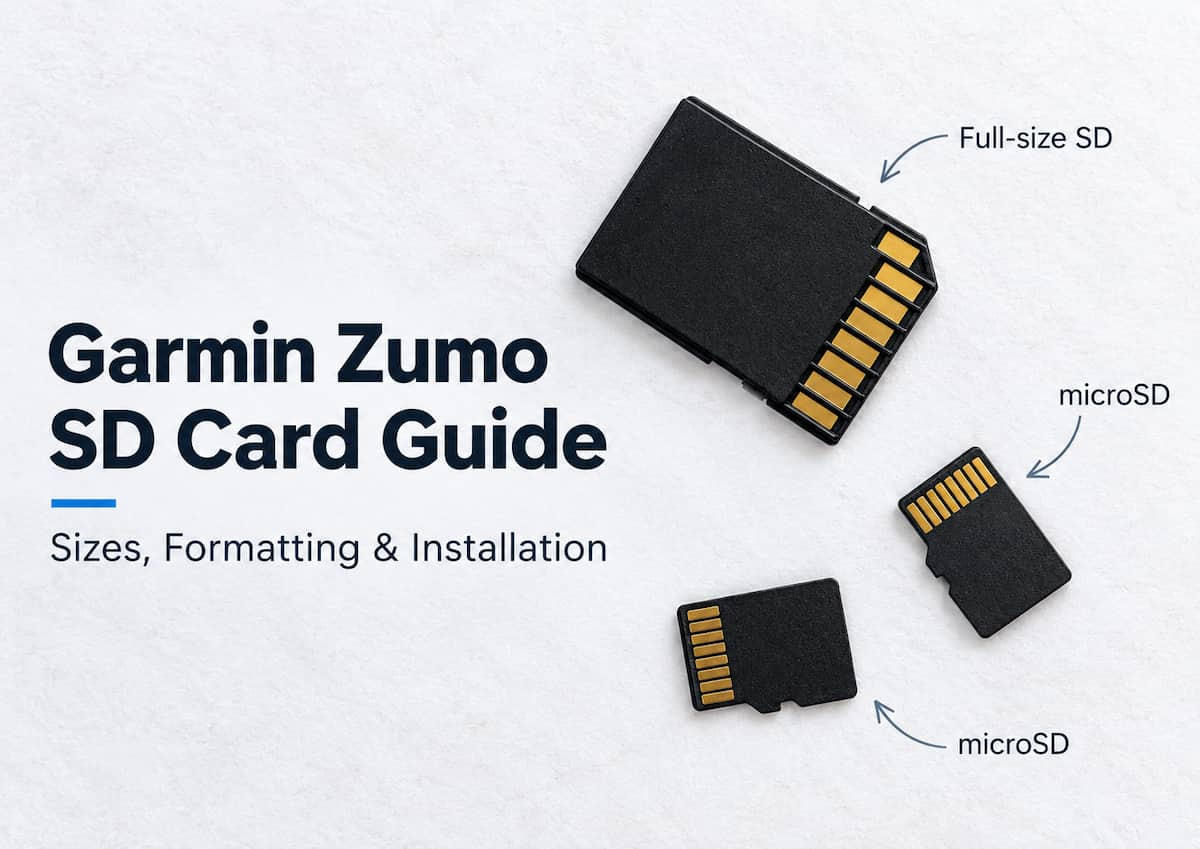
This guide explains which memory cards work with popular Garmin Zumo models, how to install them, and when to use FAT32 or exFAT. We’ll also look at several affordable microSD cards that make sense for motorcycle GPS applications.
Garmin Zumo SD Card Compatibility Chart
Before buying a card, confirm the maximum capacity supported by your particular Garmin Zumo. A 256 GB card may work perfectly in an XT3 but will exceed the supported capacity of a Zumo 595LM.
| Garmin Zumo Model | Maximum Capacity | Format |
|---|---|---|
| Zumo XT3 (4.7″ and 6″) | 256 GB | exFAT |
| Zumo XT2 | 256 GB | FAT32 |
| Zumo XT | 256 GB | FAT32 |
| Zumo 395, 396, 595 | 64 GB | FAT32 |
| Zumo 220, 350, 390, 590, 660 | 32 GB | FAT32 |
| Zumo 665 | 8 GB | FAT32 |
| Zumo 450, 550 | 4 GB | FAT32 (full-size SD) |
Important: The Zumo 450 and 550 use full-size SD cards rather than microSD cards. Most other models in the table use microSD. Check the exact model before ordering.
These limits come from Garmin’s official memory card compatibility reference and the device manuals.
Best MicroSD Cards for Garmin Zumo GPS Devices
You don’t need an expensive high-performance memory card for ordinary motorcycle navigation. A quality Class 10 card from a recognized manufacturer is generally sufficient. The important considerations are capacity, reliability and the correct file system.
SanDisk offers several good choices. The following cards are standard retail memory cards, not Garmin-specific accessories, so they must be formatted correctly for your device.
SanDisk Ultra 128 GB: Best Overall for Modern Zumo Models
The SanDisk Ultra 128 GB microSDXC is a sensible choice for the Zumo XT3, XT2 and original XT. It provides considerably more storage than most riders need for additional mapping data without paying for the largest available capacity.
This is a UHS-I, Class 10 card with an A1 performance rating. Its advertised transfer speeds are more than adequate for moving map files between a computer and the card. Those speeds do not mean the Zumo itself will operate at the card’s maximum rated transfer speed.
Best for: Zumo XT3, XT2 and XT owners who want substantial additional map storage.
SanDisk Ultra 32 GB: Best for Older Zumo Models
The SanDisk Ultra 32 GB microSDHC is particularly appealing for older Garmin motorcycle GPS devices. A 32 GB microSDHC card avoids many of the formatting complications associated with larger microSDXC cards.
It’s a practical choice for the Zumo 220, 350, 390, 590 and 660, which support a maximum of 32 GB. It can also be used in the newer XT series if you don’t need a large amount of additional storage.
Best for: Older Garmin Zumo models and anyone who wants an easily formatted FAT32 card.
SanDisk Ultra 256 GB: Maximum Storage for XT3, XT2 and XT
For those who plan to install multiple map products or maintain a large collection of supported navigation data, the SanDisk Ultra 256 GB microSDXC offers the maximum capacity supported by the XT3, XT2 and XT.
It’s worth considering if you frequently add maps or prefer to purchase one card with plenty of room for future use. However, there is little benefit in paying extra for 256 GB if a 32 or 128 GB card already meets your needs.
Remember that the XT3 requires exFAT, whereas the XT2 and original XT use FAT32. A 256 GB card may need to be reformatted before the XT2 or XT can recognize it.
Best for: Maximum supported storage on modern Garmin Zumo models.
FAT32 vs. exFAT: Why Formatting Matters
One of the most important details when buying a Garmin Zumo SD card is the file system. A memory card with the correct capacity may still be rejected if it has the wrong format.
Garmin Zumo XT3 Uses exFAT
The Zumo XT3 requires an exFAT-formatted microSD card. This is significant because many modern microSDXC cards already come formatted as exFAT, making setup easier.
If you are preparing a card on a computer, verify that exFAT is selected. Garmin’s XT3 installation instructions explicitly require this format.
Garmin Zumo XT2 and XT Use FAT32
The Zumo XT2 requires FAT32, even when using a 128 or 256 GB microSDXC card. The original XT also uses FAT32 under Garmin’s compatibility guidance.
This can create a problem on Windows computers. Windows’ standard formatting utility generally does not offer FAT32 formatting for partitions larger than 32 GB. Instead, it commonly offers exFAT or NTFS.
That doesn’t mean the XT2 or XT is limited to a 32 GB card. Both support capacities up to 256 GB, but the card must have the appropriate file system.
Garmin recommends using a smaller card if you cannot properly format a larger one. See Garmin’s instructions for memory cards of 64 GB or larger.
Before formatting: Copy any existing files you need to keep. Formatting erases the card’s contents, and a card containing purchased Garmin maps may have licensing or activation requirements.
How to Install a MicroSD Card in a Garmin Zumo
The installation process depends on the Zumo generation. The newer models have different slot arrangements from the original XT and several older motorcycle GPS devices.
Installing a Card in a Zumo XT3 or XT2
- Turn off the GPS and remove it from the motorcycle mount.
- Locate the microSD card slot using your model’s device overview diagram.
- Check the orientation of the card before inserting it. Do not force it into the opening.
- Gently press the card into the slot until it clicks into place.
- Replace any protective cover and make sure it is properly seated.
- Power on the GPS and follow any card initialization or formatting instructions.
The exact slot location differs between devices and may vary with the XT3 display size. Use the diagram in the appropriate Garmin manual rather than assuming the cards insert in precisely the same place.
Garmin provides model-specific directions for the Zumo XT2 and Zumo XT3.
Installing a Card in the Original Zumo XT
The original Zumo XT uses a covered microSD slot with a small retaining mechanism. Installation involves more than pushing the card into a spring-loaded slot.
- Turn off the GPS and remove it from its cradle.
- Lift the weather cap protecting the microSD card compartment.
- Slide the retaining cover toward the edge of the device.
- Lift the retaining cover and carefully position the microSD card against the contacts.
- Close the cover and slide it toward the center of the device to lock it.
- Replace the weather cap securely before using the GPS outdoors.
The official Zumo XT memory card instructions include an illustration of the retaining cover and card orientation.
Installing Cards in Older Garmin Zumo Models
Older Zumo devices have a variety of memory card arrangements. For example, the Zumo 595LM has a card slot accessible through its removable battery compartment.
On models with removable batteries, follow the manufacturer’s instructions before opening the compartment. Remove power as directed, locate the slot, and insert the card in the indicated orientation.
Do not assume an older Zumo uses the same arrangement as an XT-series device. Also remember that the Zumo 450 and 550 use full-size SD cards.
What Can You Store on a Garmin Zumo SD Card?
Additional microSD storage is primarily useful for mapping and navigation data. Depending on the Zumo model and software, a card can hold compatible supplemental maps, imported navigation files and other supported content.
Additional Maps
Garmin devices include built-in maps, but some riders want more specialized mapping products. Depending on the model, these may include topographical, regional or other compatible maps.
Adding a memory card can provide space for those map products without using as much internal storage. However, the card does not automatically make every Garmin map compatible with every GPS.
See our Garmin GPS Map Types Explained article for a broader discussion of mapping options.
GPX Routes, Tracks and Waypoints
GPX files can contain routes, tracks and waypoints created using compatible planning software. These files are useful when planning a motorcycle trip before leaving home or sharing routes with other riders.
A microSD card may provide a convenient way to transfer supported GPX data, although supported import procedures differ between Zumo generations. You cannot assume that simply copying a GPX file anywhere on a card will make it appear in the GPS route planner.
For more information, see our guide to using GPX files with a Garmin Zumo.
Garmin Zumo Not Recognizing the SD Card? Try These Fixes
If your Garmin Zumo does not recognize a memory card, the problem is often related to formatting, capacity or installation rather than a defective GPS.
1. Check the File System
A card formatted as exFAT may not be accepted by a Zumo XT2 or original XT. Likewise, the XT3 requires exFAT. Start by checking the card’s format on a computer.
2. Confirm the Maximum Supported Capacity
If you install a 128 GB card in a Zumo 595LM, you’re exceeding the supported 64 GB maximum. Use the compatibility table above to confirm the capacity of your device.
3. Check That the Card Is Seated Correctly
Remove the card with the unit powered down and inspect it for visible damage. Reinsert it according to the model-specific instructions. On the original XT, make sure the retaining cover is locked properly.
4. Try a Smaller Card
If you are having formatting trouble with a 128 or 256 GB microSDXC card on an XT or XT2, consider trying a 32 GB microSDHC card. It is generally easier to format as FAT32 using common computer utilities.
5. Avoid Starting the XT or XT2 With Certain Unformatted Cards
Garmin documents a specific issue in which the Zumo XT and XT2 may not start properly with an unformatted 64 GB memory card already installed.
Garmin’s suggested procedure is to start the GPS first, then insert the card when the device is running so it can prompt for formatting. Confirm the format operation carefully, since it erases existing contents.
6. Test the Card on a Computer
If the card still fails, check whether a computer can read it. A card that cannot be reliably accessed on a computer may be damaged, counterfeit or defective.
Try another known-good memory card before concluding that the GPS card slot is faulty. Avoid repeatedly formatting a card that contains the only copy of important routes or purchased maps.
Do You Really Need a 256 GB Card?
Probably not. The maximum supported capacity is not necessarily the best purchase for every rider.
For many owners, a 32 GB card is more than sufficient for additional map files. A 128 GB card provides plenty of headroom for those using modern Garmin Zumo devices, while 256 GB is useful for anyone maintaining a more extensive collection of compatible maps and data.
Also remember that a faster or larger card will not necessarily improve route calculation or satellite reception. Those functions depend on the GPS hardware, installed software and mapping data.
We would rather recommend a reliable, properly formatted 128 GB card than an unnecessarily expensive high-performance card that provides no practical benefit for navigation.
Frequently Asked Questions
What is the largest SD card a Garmin Zumo XT3 supports?
The Garmin Zumo XT3 supports microSD cards up to 256 GB. Garmin requires the exFAT file system for this model.
Can I use a 128 GB card in a Garmin Zumo XT2?
Yes. The Zumo XT2 supports microSD cards from 4 to 256 GB, provided they use FAT32 formatting. A card purchased with exFAT formatting may need to be reformatted.
Can I use the same card in an XT2 and XT3?
The two devices have different file system requirements. The XT2 requires FAT32 while the XT3 requires exFAT. Don’t assume a card prepared for one model will work in the other without reformatting. Formatting removes existing data.
Does a Garmin Zumo need a microSD card to operate?
No. Garmin Zumo GPS devices have internal storage and can operate without an optional memory card. A card is primarily useful when additional space is needed for compatible maps and other data.
Will a faster microSD card make my Zumo calculate routes faster?
Not necessarily. A faster card may improve file transfers on compatible equipment, but route calculation depends on the GPS processor, software and map data. A reliable Class 10 card is a reasonable choice.
Can I move a Garmin map card between different GPS devices?
Not always. Garmin map products may have device compatibility, licensing and activation restrictions. Do not assume a purchased or preloaded map card can be copied or transferred freely to another GPS.
Final Thoughts: Which Garmin Zumo SD Card Should You Buy?
For the Garmin Zumo XT3, XT2 and original XT, a SanDisk Ultra 128 GB microSDXC card strikes a useful balance between capacity and cost. It’s large enough for substantial additional mapping data without going all the way to the maximum supported capacity.
For older Garmin Zumo models, a SanDisk Ultra 32 GB microSDHC card is often the more practical purchase, provided your model supports that capacity.
Whichever card you choose, confirm your Zumo’s capacity limit and required file system before installing it. Getting those two details right is more important than buying the fastest memory card on the market.