Why is a motorcycle GPS so expensive when a smartphone can provide turn-by-turn directions for free? It’s a reasonable question, particularly when a dedicated motorcycle navigator costs considerably more than a typical automotive GPS. The difference comes down to more than the name on the front. A motorcycle GPS is designed to survive exposure to weather, handle vibration, remain readable in sunlight and provide routing features developed specifically for motorcycle riding. But with smartphones and motorcycle CarPlay displays improving every year, is paying extra for a Garmin Zumo still worthwhile?
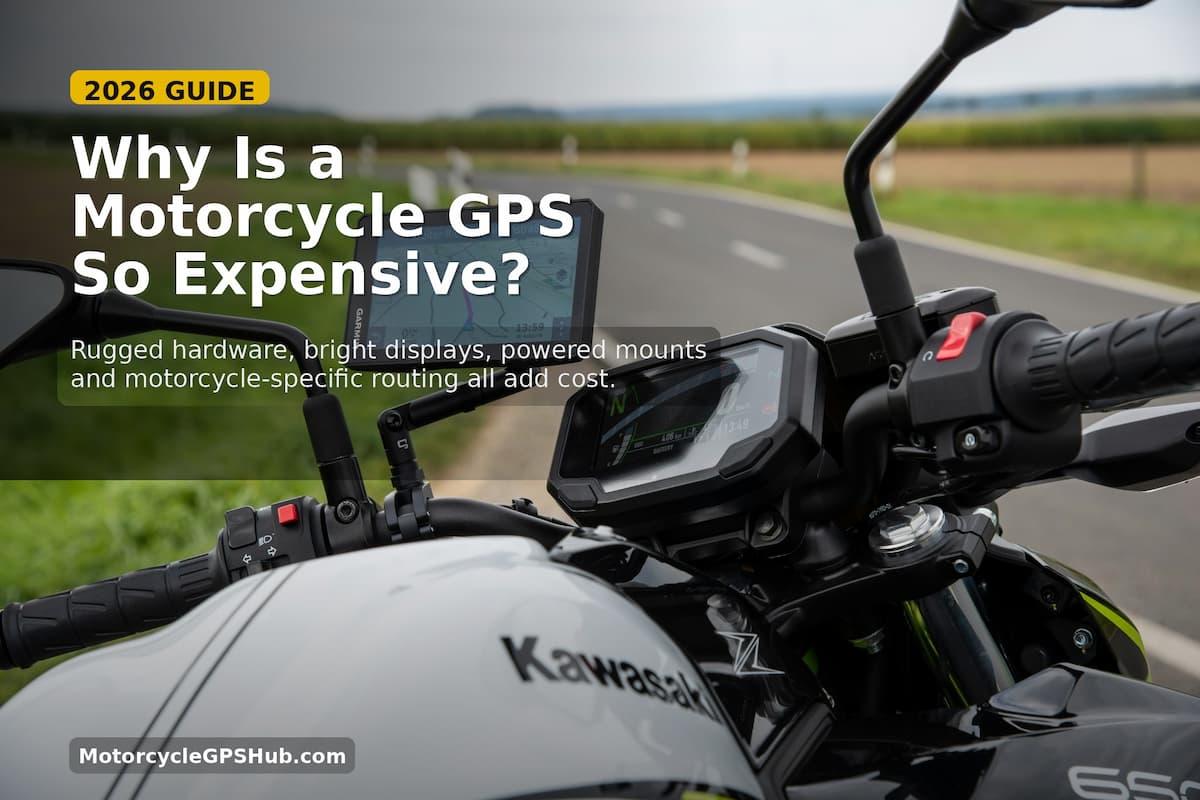
Quick Answer: Motorcycle GPS units are expensive because they combine rugged, weather-resistant construction, glove-friendly sunlight-readable displays, motorcycle-specific navigation software and secure powered mounting systems. A dedicated GPS makes the most sense for frequent touring and adventure riding. For occasional rides and everyday commuting, a smartphone or motorcycle CarPlay display may provide everything you need at a lower cost.
1. Motorcycle GPS Units Are Built for a Tougher Environment
The biggest difference between a motorcycle GPS and an ordinary automotive GPS is where the device operates. A car GPS spends its life inside a relatively protected environment. It doesn’t normally get rained on, covered in road dust or subjected directly to wind and the vibration of motorcycle handlebars.
A motorcycle navigator has to contend with all of those conditions. Its enclosure, seals, connectors and mounting hardware must be designed for an exposed installation. That requires a different approach to construction, environmental testing and long-term durability than a navigation device intended to sit behind a windshield.
Water Resistance Is a Major Part of the Cost
Garmin’s current Zumo XT3 carries an IPX7 water-resistance rating. Under the applicable test standard, that means the device can withstand incidental immersion in water up to one meter deep for 30 minutes under specified conditions. It is a meaningful level of protection for equipment intended to encounter rain while riding.
The XT3 also carries an IP6X dust-resistance rating. The first rating addresses water, while the second addresses dust. These are separate qualifications, and both matter when a navigator is used outdoors on paved and unpaved roads.
Water resistance does not make a device indestructible or guarantee protection against every possible exposure. Damaged seals, improperly closed covers and extreme conditions can still cause problems. Nevertheless, this type of environmental protection is something most ordinary car GPS devices are not designed to provide.
Vibration Resistance Matters Too
A motorcycle can expose an attached electronic device to considerable vibration, especially when the navigator is mounted directly to the handlebars. The amount and frequency of vibration vary depending on engine design, riding conditions and mounting location.
A motorcycle GPS must tolerate that environment without the screen, housing, electrical connections or internal components developing problems. Garmin specifically designs the XT3 for handlebar vibration and also lists MIL-STD-810 drop-related durability testing. That doesn’t mean the GPS can survive unlimited abuse, but it does demonstrate that durability is part of the product’s intended design.
These additional requirements help explain why comparing a motorcycle GPS directly with an inexpensive car navigator isn’t a particularly fair comparison.
2. The Display Is Designed for Sunlight and Motorcycle Gloves
One of the most expensive-looking components of a modern GPS is its display, and motorcycle navigation places some unusual demands on it. The screen needs to be readable in bright outdoor conditions while remaining useful in shade, under changing light and during evening rides.
An automotive GPS is generally protected from direct sunlight by the vehicle interior. A motorcycle navigator may have the sun shining directly onto its display for hours. High-brightness screens, display coatings and careful optical design help maintain visibility under those conditions.
Touchscreen operation is another consideration. Many motorcycle riders wear thick protective gloves, sometimes with fingertips that do not operate ordinary capacitive touchscreens reliably. A motorcycle GPS such as the Zumo XT3 is designed to support operation with gloves, reducing the need to remove them whenever the rider needs to change a setting.
Modern smartphones can also have excellent displays, and some offer exceptional peak brightness. The distinction is that a motorcycle GPS combines outdoor visibility and glove operation as core design requirements rather than treating them as occasional use cases.
That combination adds cost, but it’s also among the features a rider is most likely to appreciate during regular use.
3. Motorcycle GPS Mounts and Powered Cradles Cost More
This is one area where the higher price makes a great deal of sense. A typical automotive GPS uses a small suction cup mount and a power cable plugged into the vehicle’s accessory outlet. A motorcycle GPS requires a much more substantial arrangement.
A dedicated motorcycle mounting system commonly includes a handlebar or other motorcycle mounting base, an adjustable arm or bracket, a device-specific cradle and the necessary mounting hardware. Some models include a powered cradle with electrical contacts and a dedicated motorcycle wiring harness.
These components have to accomplish several tasks at once. They must keep the GPS securely attached over rough pavement, maintain the desired viewing angle and avoid interfering with the motorcycle’s controls. A powered cradle also needs to maintain a reliable electrical connection despite vibration and exposure to the elements.
The current Garmin Zumo XT3 illustrates the difference. Garmin supplies post-mount hardware with the 4.7-inch version and a handlebar mounting kit with a U-bolt base for the 6-inch version. The included hardware differs because the devices are intended to accommodate different motorcycle layouts.
The mount may not be the most exciting part of a GPS purchase, but it is essential. A navigator that constantly slips out of position or loses power when the motorcycle encounters a bump isn’t particularly useful, regardless of how good its maps are.
Our motorcycle GPS mounting and installation guide explains handlebar, brake/clutch and fork-stem mounting options, along with the important details of positioning and electrical power.
4. Motorcycle Routing Software Is More Specialized
Most automotive navigation software is designed around a relatively simple objective: get the driver to a destination efficiently. Depending on the settings, that might mean the fastest route, the shortest distance or a route that avoids toll roads.
Motorcyclists often want something different. The destination might be a secondary consideration, while the roads taken to get there are the main attraction. A scenic mountain road with a dozen curves may be considerably more appealing than a straight highway, even when it adds time to the trip.
Garmin’s Adventurous Routing feature addresses this by favoring curvy roads, hills and fewer highways. The rider can adjust how adventurous the route should be, allowing the GPS to look for a more entertaining ride rather than focusing exclusively on travel time.
Route Planning, GPX Files and Ride Discovery
Modern Garmin Zumo devices provide more than basic turn-by-turn navigation. They support route shaping, multiple stops, imported routes and tracks, and motorcycle-oriented mapping features. The XT3 also offers Popular Moto Paths, which highlights roads commonly used by motorcyclists, and Great Rides, which helps riders discover routes shared by others.
GPX support is particularly valuable for organized rides and long-distance touring. A GPX file can contain route, track and waypoint information that allows riders to share a planned trip instead of manually entering every road and destination. The details of how a device interprets a GPX route can vary, so importing a file doesn’t always guarantee identical navigation across different systems.
For more information, see our Garmin Zumo GPX import guide, which covers the XT, XT2 and XT3.
Specialized navigation software requires development, maintenance, licensing and continued support. Not every feature involves a separate mapping fee, however. The XT3 includes street and topographic mapping, while additional premium content is available through optional services such as Garmin Outdoor Maps+.
Those optional subscriptions shouldn’t be confused with the GPS hardware itself. A rider does not need to subscribe to every Garmin service to use the device for ordinary navigation.
5. Dedicated Motorcycle GPS Devices Work Independently of Your Phone
One of the conveniences of a dedicated motorcycle GPS is that its primary navigation system doesn’t depend on a connected smartphone. Its satellite receiver, installed maps and routing software are contained in the navigator itself.
That can be useful when touring in areas where cellular coverage is unreliable or when you prefer to keep your phone protected in a pocket or luggage compartment. A properly configured Zumo can continue to provide navigation using its stored maps even when there is no cellular service.
There is an important distinction here: GPS positioning and cellular data are not the same thing. Smartphones also contain satellite positioning receivers and can navigate without cellular coverage when the necessary maps and navigation functions are available offline. A phone doesn’t automatically lose its ability to determine location when it loses service.
What the dedicated GPS provides is a self-contained system built around offline navigation from the beginning. Smartphone-connected services such as live traffic, certain searches, weather information and group communication may still require connectivity, even when basic route guidance does not.
6. Why Not Just Use a Smartphone Instead?
This is the strongest argument against buying an expensive motorcycle GPS. Most riders already own a smartphone with excellent navigation capabilities. Google Maps, Waze and motorcycle-oriented navigation apps provide useful routing features without requiring the purchase of another display and GPS receiver.
For commuting, local rides and occasional weekend trips, a properly mounted smartphone may be all the navigation equipment necessary. The familiarity of the apps is a major advantage, and keeping maps, addresses and destinations synchronized with the phone can be convenient.
There are some disadvantages worth considering, however. Direct sunlight can make a phone hot enough to limit performance or charging. Rain and moisture around charging connectors can cause difficulties, and glove operation may be inconsistent depending on the phone and gloves being used.
Vibration also deserves attention. Apple has warned that exposure to certain high-amplitude motorcycle vibrations can affect camera systems on some iPhone models. A suitable vibration-dampening mount can help reduce exposure, but riders should follow the phone manufacturer’s guidance rather than assuming any ordinary handlebar holder is sufficient.
A phone also performs many tasks besides navigation. If it’s the rider’s main communications device, there can be advantages to keeping it protected and readily available for emergencies rather than exposing it to the weather throughout a long ride.
None of those drawbacks makes smartphone navigation a bad choice. It simply means that the lower cost comes with a different set of compromises. Our guide to using a smartphone as a motorcycle GPS discusses this approach in greater detail.
7. Motorcycle CarPlay and Android Auto Displays Offer a Middle Ground
One of the most important changes in motorcycle navigation has been the growing availability of dedicated motorcycle displays that support Apple CarPlay and Android Auto. These provide a separate screen on the handlebars while allowing the connected smartphone to handle navigation and other compatible applications.
The idea is appealing because the phone can remain in a protected location while a purpose-built display provides access to maps, music and other supported functions. Depending on the model, motorcycle displays may also offer weather-resistant construction, glove-compatible operation and mounting hardware intended for motorcycle use.
There is a significant difference between these displays and a standalone GPS. Most motorcycle CarPlay and Android Auto units are interfaces for a connected phone, not independent navigation computers with their own complete mapping systems. If the phone is unavailable, the display generally cannot provide the same navigation functions on its own.
Offline navigation may still be possible when the connected phone’s mapping application supports it and the necessary maps have been downloaded. Features, connectivity requirements and hardware specifications vary considerably between display manufacturers.
For riders who primarily use familiar phone apps but don’t want the phone exposed on the handlebars, this can be a particularly attractive alternative to an expensive Garmin Zumo.
8. What Are You Paying For With a Garmin Zumo XT3?
The Garmin Zumo XT3 provides a useful example of how far dedicated motorcycle GPS technology has developed. Introduced in 2026, it is available with either a 4.7-inch or 6-inch display, both with a 1280 x 720 resolution. Garmin designed the device for motorcycle vibration and outdoor use, with IPX7 water resistance, IP6X dust protection and MIL-STD-810 drop-related testing.
The XT3 includes 64 GB of internal storage, supports microSD expansion and offers 25 Hz multi-GNSS positioning. It also provides a live lean-angle gauge and compatibility with Garmin’s optional Performance Package, which adds features intended for closed-course riding and track analysis.
These are substantial capabilities, although not all of them are necessary for navigation. A touring rider may care more about weather resistance, route planning and display visibility than about lean-angle data or lap timing.
We cover the specifications, differences between screen sizes and whether it’s worth upgrading from an older model in our Garmin Zumo XT3 review.
Garmin Zumo XT3 Motorcycle GPS
For riders who want a dedicated motorcycle navigation system, the 6-inch Zumo XT3 combines a bright glove-friendly display, powered motorcycle mounting, rugged construction and specialized routing features.
9. Motorcycle GPS vs Smartphone vs CarPlay Display
Before spending money on a dedicated navigator, it helps to compare the different ways to navigate on a motorcycle. Each approach has strengths, and the most expensive option is not necessarily the best choice for every rider.
| Feature | Motorcycle GPS | Smartphone | CarPlay / Android Auto |
|---|---|---|---|
| Additional hardware cost | High | Low if already owned | Varies by display |
| Weather protection | Designed for motorcycle use | Depends on phone and setup | Depends on model |
| Glove operation | Designed for gloves | Varies | Varies by display |
| Offline navigation | Built in with stored maps | With compatible offline maps | Depends on connected phone and app |
| Requires a smartphone | No, for basic navigation | Yes | Usually yes |
| Motorcycle route planning | Built into selected models | Available through specialized apps | Depends on compatible apps |
| Best suited for | Touring and adventure riding | Commuting and occasional rides | Phone navigation with a separate display |
Another possibility is using an automotive GPS on a motorcycle. That can work, particularly when the rider already owns the device, but it introduces limitations involving weather resistance, mounting and glove operation. We discuss those compromises in our Garmin Drive GPS on a motorcycle guide.
10. Who Should Spend the Money on a Motorcycle GPS?
A dedicated motorcycle GPS is easiest to justify when navigation is a regular and important part of riding. Someone who takes multi-day touring trips, travels through unfamiliar areas and frequently builds detailed routes is more likely to appreciate the capabilities of a self-contained navigator.
Adventure and dual-sport riders are another group worth considering. Mapping choices, offline operation, GPX support and hardware durability may become more important when rides include remote areas or unimproved roads. The ability to install the GPS permanently and power it from the motorcycle is also convenient for riders who use navigation on nearly every trip.
There is a long-term ownership consideration as well. A dedicated GPS can remain attached to the motorcycle while a smartphone is replaced every few years. That doesn’t eliminate the need to maintain maps, software or mounting accessories, but it can reduce the disruption associated with changing phones or navigation apps.
For someone who rides frequently and intends to keep the equipment for several years, the higher purchase price may be a reasonable investment.
11. When an Expensive Motorcycle GPS Is Not Worth Buying
Not everybody needs a Garmin Zumo, and it’s important to recognize when the additional features won’t provide much value. A rider who travels familiar routes, occasionally needs directions to a restaurant and rarely leaves areas with dependable cellular coverage may gain very little from purchasing a dedicated navigator.
The same applies to someone who already has a good smartphone mounting system and is comfortable using an appropriate navigation app. Buying an expensive GPS simply to duplicate directions that are already available on the phone isn’t a compelling use of money.
Even among dedicated GPS buyers, the most expensive current model isn’t always necessary. A properly functioning older Zumo can still provide useful motorcycle navigation. If its maps are supported, battery and mounting system are in acceptable condition, and it performs the tasks you need, there may be little reason to replace it immediately.
The real question isn’t whether the newest GPS offers more features. It is whether those additional features will improve your riding experience enough to justify the cost.
12. How to Get More Value From a Motorcycle GPS
If you decide a dedicated navigator is the right choice, there are ways to make the purchase more worthwhile. Start by selecting a screen size that suits your motorcycle rather than automatically purchasing the largest available display. A smaller device may be easier to position and may leave more room around the instrument panel.
Make sure you understand which motorcycle mounting components and power connections are included with the GPS. A package that already contains the hardware appropriate for your motorcycle may cost less overall than one requiring several additional adapters.
Keep the navigation software and installed maps updated, and learn to use route planning and GPX files rather than limiting the device to basic destination searches. Those capabilities are a significant part of what you paid for.
Finally, remove the GPS when parking in an unsecured location and protect exposed cradle contacts according to the manufacturer’s instructions. A little care can help preserve a device that represents a substantial investment.
Frequently Asked Questions
Why does a Garmin Zumo cost more than a Garmin Drive?
A Garmin Zumo is designed for use on an exposed motorcycle, while a Garmin Drive is primarily intended for an automotive interior. The Zumo adds motorcycle-oriented construction, weather resistance, glove-friendly display operation, specialized routing features and motorcycle mounting and power hardware. These requirements help explain the difference in price.
Is a motorcycle GPS more accurate than a phone?
Not necessarily. Both modern smartphones and dedicated motorcycle GPS devices can provide accurate satellite positioning. Performance depends on the receiver, antenna, surrounding conditions and software. Some dedicated units, including the Zumo XT3, offer more advanced positioning specifications, but those do not automatically translate into meaningfully better directions on an ordinary road.
Does a motorcycle GPS need a cellular connection?
No. A dedicated GPS with installed maps can provide basic navigation without cellular service. Some connected services, including live traffic, weather and certain group features, may need a smartphone or other communications connection. Smartphones can also provide offline navigation when supported maps have been downloaded in advance.
Are motorcycle GPS units waterproof?
Many dedicated motorcycle GPS devices have published water-resistance ratings. For example, the Garmin Zumo XT3 carries an IPX7 rating. Always check the rating of the specific device, since not all motorcycle navigation products offer the same protection. Water resistance should not be interpreted as protection against every possible weather or cleaning condition.
Is a dedicated motorcycle GPS better than a CarPlay display?
It depends on how you ride. A dedicated motorcycle GPS is generally preferable when you want independent navigation, motorcycle-specific routing and installed offline maps. A CarPlay or Android Auto display can be an excellent choice when you prefer smartphone navigation apps but want a separate screen mounted on the motorcycle. Neither option is automatically superior for every rider.
Final Verdict: Is an Expensive Motorcycle GPS Worth It?
There are legitimate reasons why motorcycle GPS devices cost more than automotive navigators. Weather protection, vibration resistance, outdoor displays, specialized routing software and motorcycle mounting systems all contribute to the price. A modern Garmin Zumo is not simply a conventional GPS placed inside a waterproof enclosure.
That said, the smartphone has changed the economics of motorcycle navigation. Riders no longer need to buy a dedicated GPS simply to obtain reliable directions, and motorcycle CarPlay displays provide another practical alternative.
Our recommendation is to buy a dedicated motorcycle GPS when you will regularly benefit from its motorcycle-specific features, not merely because it is the most expensive navigation option. For serious touring and adventure riding, the additional investment can make sense. For occasional rides around town, save the money and use the navigation equipment you already own.
If you’re still comparing equipment, start with our best motorcycle GPS and navigation systems guide for a broader look at the available options.