Dealing with motorcycle GPS sun glare can turn an otherwise sharp navigation display into an unreadable mirror right when you need turn-by-turn directions in heavy traffic. The washout is especially noticeable when bright sunlight strikes the screen from directly above or over your shoulder, hiding road labels, route lines, and upcoming junction arrows behind a wall of white reflection. Even a high-brightness dedicated motorcycle navigator can lose contrast under harsh midday light or awkward cockpit angles.
Before ordering an aftermarket GPS sunshade, it pays to work through a few free mechanical and display adjustments on your bike. Changing your backlight settings, tweaking the tilt angle of your ball mount, and checking how your helmet visor or sunglasses interact with the screen often make an immediate improvement. Our recommendations draw on 20 years of experience selling and evaluating GPS devices and mounting equipment, supported by product research and technical analysis.
Quick answer: To reduce motorcycle GPS sun glare, start by setting your display brightness to 100%, locking the map into daytime color mode, and tilting your RAM mount slightly downward or more upright so the glass reflects dark cockpit parts instead of the sky. If sunlight still washes out the map, install a strap-mounted GPS sun visor to block overhead light, apply a model-specific matte anti-glare screen protector to diffuse mirror reflections, and check whether polarized sunglasses are darkening the LCD panel.
Why Motorcycle GPS Screens Become Hard to Read in Sunlight
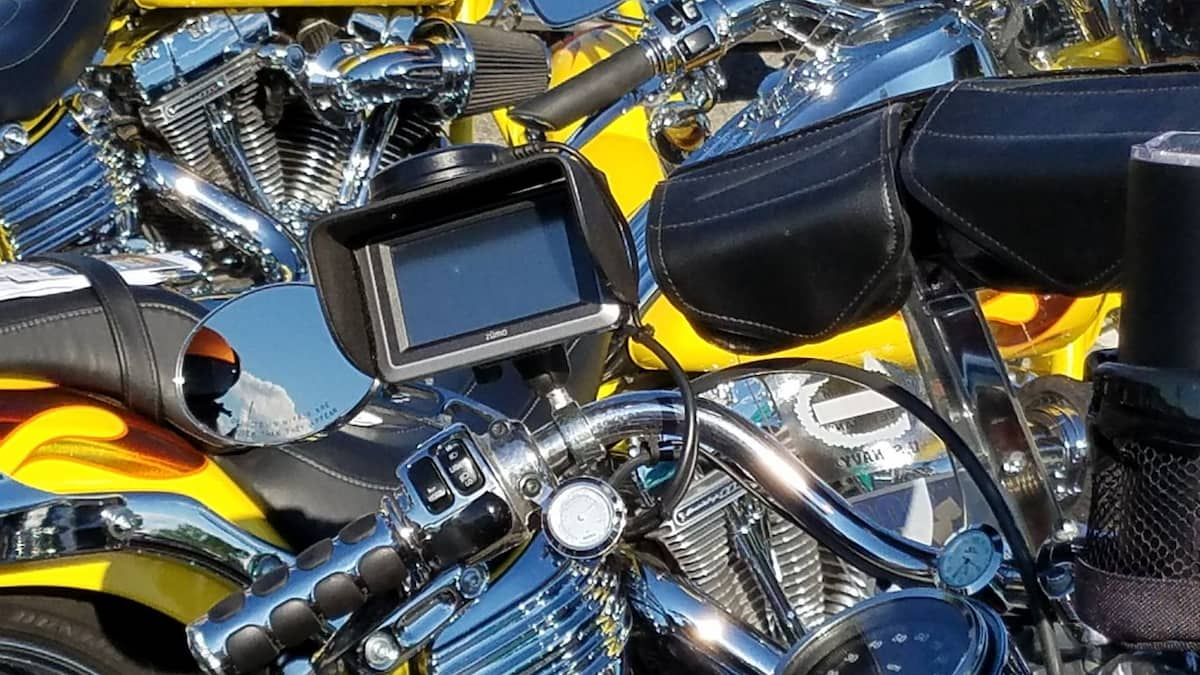
Not every daytime visibility problem comes from the same optical source. Sometimes direct sunlight hits the glass face of the navigator and overpowers the internal LED backlight, making the color map look pale and washed out. At other times, the smooth glass surface acts like a mirror, reflecting the bright sky overhead, a white helmet, a high-visibility riding jacket, or chrome handlebar clamps directly into your line of sight.
The angle of the sun relative to your direction of travel dictates which fix will work best. A high midday sun shining down on the cockpit is relatively easy to block with a top-mounted visor or hood that casts a shadow across the upper half of the display. When the sun drops low behind your back in the early morning or late afternoon, light hits the screen straight on at an angle that a shallow top visor cannot block, making mounting tilt, matte screen diffusion, and screen brightness far more important.
A dusty, bug-splattered, or fingerprint-smeared touchscreen also scatters incoming sunlight across the glass and makes glare look much worse than it really is. Before spending money on an accessory hood or screen film, wipe the glass clean and figure out whether you are fighting specular sky reflections, an underpowered backlight, or a polarization mismatch with your riding glasses.
1. Increase Brightness and Check the GPS Display Settings
The fastest improvement costs nothing and takes thirty seconds in the menu. Many riders set their GPS brightness inside a shaded garage when first setting up the unit and never touch it again, leaving the backlight at 60% or 70% where it looks crisp indoors but disappears under direct afternoon sun.
On a Garmin Zumo XT3, open Settings > Display and drag the brightness slider all the way to 100%. In that same menu, check the Color Mode setting, which lets you choose between Day, Night, or Automatic. The Garmin Zumo XT2 and original 5.5-inch Zumo XT use a very similar display control layout, and Garmin provides an official Zumo XT3 display-settings guide covering the exact menu items.
For bright daytime riding, verify that your navigator is not accidentally locked in its dark Night color palette or dimmed by a low-battery power-saving profile. A high-contrast daytime map theme with a light background is much easier for your eyes to pick up through a tinted helmet shield. While running a motorcycle GPS at full 100% backlight draws more power (reducing the Zumo XT3’s standalone battery claim from up to seven hours down to roughly five hours), that power draw is not a concern when the unit is snapped into its hardwired 12V motorcycle cradle.
2. Adjust the Motorcycle GPS Mounting Angle
Changing the pitch and yaw of your GPS screen is often more effective than strapping on a plastic sunshade. Because the angle of incidence equals the angle of reflection, a GPS tilted upward toward the rider’s face almost always reflects the bright sky or clouds overhead. Pivoting the top of the screen slightly forward toward a more vertical or subtly downward-facing angle shifts that reflection zone down toward your dark jacket chest or tank bag, immediately restoring map contrast.
With the motorcycle parked on level ground, sit in your normal riding posture wearing your helmet and loosen the wingnut on your RAM double-socket arm just enough to pivot the cradle. Make small, incremental changes to the screen tilt until the sky reflection drops out of your viewing window without forcing you to dip your chin far away from the road ahead. If your current setup uses a short stubby mount that cannot angle upright without hitting the handlebar clamp or brake reservoir, swapping in a RAM-B-201U medium double-socket arm (3.73 inches overall for 1-inch B-size balls) gives you the extra articulation reach needed to stand the screen up out of the glare zone.
Do not assume that mounting the GPS higher above the instruments always improves visibility. Placing a navigator behind a tinted or sculpted touring windscreen can sometimes shade the unit from wind and rain, while repositioning it just an inch lower or closer to the center riser can move it out of a troublesome glare path. After retightening the arm knob while parked, always turn the handlebars from full left lock to full right lock to verify that the new screen angle still clears the fuel tank, windscreen, and control cables, as detailed in our motorcycle GPS mount and installation guide.
3. Use a Strap-Mounted GPS Sun Shade Visor
A GPS sunshade, also called a sun visor or glare hood, projects a small three-sided roof above the top bezel and along the left and right edges of the display. Its job is to cast a physical shadow across the upper portion of the glass so overhead midday sunlight cannot strike the touchscreen directly.
When shopping on Amazon for a GPS visor, how the hood attaches to the housing is the most important detail for motorcycle use. Cheap automotive clip-on visors that rely on a spring-loaded jaw or shallow friction tabs are built for smooth car dashboards; on a motorcycle, highway wind buffeting and engine vibration can quickly shake a loose friction clip off the bezel. With older hook-and-loop fabric visors like the legacy GlareStomper now discontinued, the most reliable universal design on Amazon is a strap-retained rigid visor.
The DigiCharge 6-Inch GPS Sun Shade Visor uses a molded matte-black hood that seats against the front outer bezel of 5.5-inch and 6-inch navigators (including the 6-inch Garmin Zumo XT3, 6-inch Zumo XT2, 5.5-inch Zumo XT, and 6-inch Garmin DriveSmart units) and secures with dual tensioned elastic straps that wrap behind the outer edges of the body. Because the two straps sit near the left and right ends of the shell, they leave the center rear cradle boss unobstructed on most mounts and will not pop loose when you hit a bump.
Important: Whenever you install a strap-mounted visor on a powered motorcycle cradle, verify that the rear elastic straps sit strictly on the outer wings of the GPS body and do not pass over the gold weatherproof charging pins or prevent the top mechanical latch from clicking all the way shut. Also confirm that the visor is sized for your screen class: a 6-inch visor fits the 6-inch Zumo XT3, 6-inch XT2, and 5.5-inch XT, but will be too wide for the compact 4.7-inch Zumo XT3.
4. Apply a Matte Anti-Glare Screen Protector
A matte anti-glare screen protector tackles reflections right at the surface of the glass rather than shading the unit from above. Instead of leaving a glossy, mirror-smooth finish that bounces images of white clouds or your riding jacket straight into your helmet visor, a matte protector uses a microscopic etched surface that scatters and diffuses reflected light across the panel.
For many riders on unfaired cruisers, naked bikes, and upright adventure motorcycles, a matte screen protector is more practical than a deep plastic hood because it adds zero wind profile, never interferes with the powered cradle latch, and softens reflections even when the sun is low behind your shoulders. The minor tradeoff is a slight reduction in pin-sharp contrast and a velvety surface texture, though quality motorcycle-cut films preserve full capacitive touch sensitivity with riding gloves.
For 6-Inch Garmin Zumo XT3 and Zumo XT2
Because the 6-inch Garmin Zumo XT3 and 6-inch Zumo XT2 share the same 6-inch display dimensions, the Ermorgen Matte Anti-Glare Screen Protector 2-Pack and Silicone Case Kit fits both models directly. It includes two precision-cut matte anti-glare films that cut down on mirror reflections and fingerprint smudges, paired with a form-fitting silicone frame that protects the outer bezel off the bike.
For Original 5.5-Inch Garmin Zumo XT
If you ride with the original 5.5-inch Garmin Zumo XT, do not order a 6-inch XT2/XT3 sheet. Instead, the BoxWave ClearTouch Anti-Glare (2-Pack) for Garmin Zumo XT is cut specifically for the 5.5-inch screen and uses a glueless matte dual-layered film that disperses overhead glare without leaving sticky residue on the glass.
5. Check Polarized Sunglasses, Helmet Visors, and Audio Prompts
Sometimes the navigator is working properly and your eyewear is the culprit. Many LCD and TFT navigation displays emit polarized light. When you look at the screen through polarized sunglasses, the two polarization axes can clash, making the GPS display appear almost completely black, purple, or blotchy at either landscape or portrait viewing angles.
If your GPS screen suddenly looks dim on sunny days, park the motorcycle safely and look at the display with your sunglasses on, then lift them to compare the bare screen. Also check whether an aftermarket iridium, mirrored, or photochromic helmet shield is cutting too much light. Never take off eyewear or ride with an open visor in moving traffic to read a map; test your gear combination before leaving the driveway and switch to non-polarized riding glasses if polarization blackout is the issue.
Keeping a clean microfiber cloth in your tank bag or fairing pocket also makes a real difference on multi-day trips. Wipe away dried rain spots, bug residue, and skin oils using only water or a cleaner approved by the GPS manufacturer so you do not strip factory anti-reflective coatings. Finally, pairing your navigator with a helmet communicator lets you rely on spoken turn-by-turn street names when the sun is right at your back, so you do not have to stare at a washed-out screen. See our motorcycle Bluetooth headset guide for compatible audio options.
Which Motorcycle GPS Glare Solution Should You Try First?
Because different sunlight angles create different visibility problems, matching the symptom to the right fix saves money and avoids cluttering your handlebars with unnecessary accessories.
| Visibility Symptom | Best First Step | Amazon Upgrade Option |
|---|---|---|
| Screen looks dim in all outdoor light | Set brightness to 100% and select Day color mode | Upgrade to a high-brightness Garmin Zumo XT3 |
| Bright sky or jacket reflects like a mirror | Tilt the mount more upright or slightly downward | RAM-B-201U Medium Arm + Matte Anti-Glare Film |
| Overhead midday sun washes out map contrast | Reposition screen closer to rider line of sight | DigiCharge 6-Inch Strap-Mount GPS Sun Visor |
| Screen turns dark or blotchy at certain head angles | Compare screen while parked with and without sunglasses | Switch to non-polarized riding eyewear |
| Hazy glare appears across the entire glass face | Clean dust, bug film, and fingerprints with microfiber | Install a fresh BoxWave or Ermorgen matte film |
Will a GPS Sunshade Eliminate All Glare?
No accessory eliminates every reflection at every hour of the day. A physical sunshade works by blocking light rays arriving from above and slightly to the sides of the bezel. When the sun sits low on the horizon directly behind your shoulders, sunlight shines straight into the open front of the hood, where even a deep visor cannot cast a shadow across the screen.
While a deeper three-sided hood shades more of the glass than a shallow top lip, excessively deep visors have practical downsides on a motorcycle. A deep tunnel can block your gloved fingers from reaching corner menu icons, cast a larger wind profile at highway speeds, or bump against your windscreen or tank bag at full steering lock. That is why many riders pair a matte anti-glare screen protector with a better RAM mounting angle first, and reserve a strap-on visor for cockpits that catch severe overhead glare.
Does the Garmin Zumo XT3 Need a Sunshade?
The Garmin Zumo XT3 comes from the factory with a high-brightness HD touchscreen (1280 x 720 resolution) built specifically for open-cockpit motorcycle use, so you should not buy a sun visor automatically before riding with the unit. Once the backlight is set to 100% on its powered mount and the RAM arm is angled away from the sky, most riders find the bare XT3 display far easier to read in direct sun than an automotive GPS or an overheating smartphone.
Even so, no glass touchscreen is completely immune to harsh glare on an unfaired cruiser or upright adventure bike when the sun lines up behind the rider. If you are riding with an older, dimmer automotive GPS or a decade-old motorcycle unit that washes out in every sunny intersection, upgrading to a modern display makes the biggest difference of all. Read our full Garmin Zumo XT3 review for complete details on its 4.7-inch and 6-inch screens, mounting cradle, and daytime readability.
Frequently Asked Questions
Are clip-on GPS sunshades safe for motorcycle use?
Generic automotive clip-on visors that rely on a loose friction clamp or spring jaw are a poor choice for motorcycles because wind buffeting and road vibration can shake them off at highway speeds. If you want a removable visor for a 5.5-inch or 6-inch GPS, choose a strap-retained visor like the DigiCharge 6-inch hood whose elastic straps wrap behind the outer edges of the housing, and always verify that the cradle latch locks securely before riding.
Is GlareStomper still available for motorcycle GPS units?
No, the original hook-and-loop fabric GlareStomper GPS sunshields have been discontinued and are no longer stocked on Amazon. Today, riders either apply a precision-cut matte anti-glare screen protector to diffuse reflections directly on the glass or use an elastic strap-mounted visor hood that wraps around the outer bezel.
Is a matte screen protector better than a sunshade?
They solve two different optical problems. A sunshade blocks direct overhead sunlight from hitting the glass, while a matte screen protector diffuses mirror-like reflections of the sky or your jacket across the surface of the display. Because a matte screen protector never catches wind or interferes with your cradle latch, it is often the cleanest accessory to try right after adjusting your RAM mount angle.
Should I replace my motorcycle GPS because of sun glare?
Not before you have tested maximum brightness, daytime color mode, a steeper mounting angle, and non-polarized eyewear. However, if you are riding with an older automotive Garmin Nuvi or Drive unit, or a decade-old motorcycle GPS whose backlight has dimmed with age, no visor will give it the outdoor contrast of a modern high-brightness motorcycle display. Our motorcycle GPS buying guide covers the brightest current replacement options.
Bottom Line
Conquering motorcycle GPS sun glare starts with free adjustments in the driveway: crank the display brightness to 100%, confirm that daytime map colors are active, and pivot your RAM mount so the screen stops acting like a skyward mirror. Once you rule out polarized sunglasses and clean the glass, adding a model-specific matte anti-glare screen protector or a strap-retained 6-inch sun visor will tame harsh reflections and make every navigation glance quicker and safer.