Building an effective motorcycle GPS anti-theft setup requires protecting two separate targets on your handlebars: the removable GPS screen itself and the hardwired powered cradle bolted to your RAM mount arm. If a determined thief arrives with heavy pry tools and plenty of time, they can break almost any physical lock on a parked bike. However, most roadside GPS thefts are crimes of opportunity that happen in less than ten seconds while a rider steps inside a gas station, coffee shop, or rest stop.
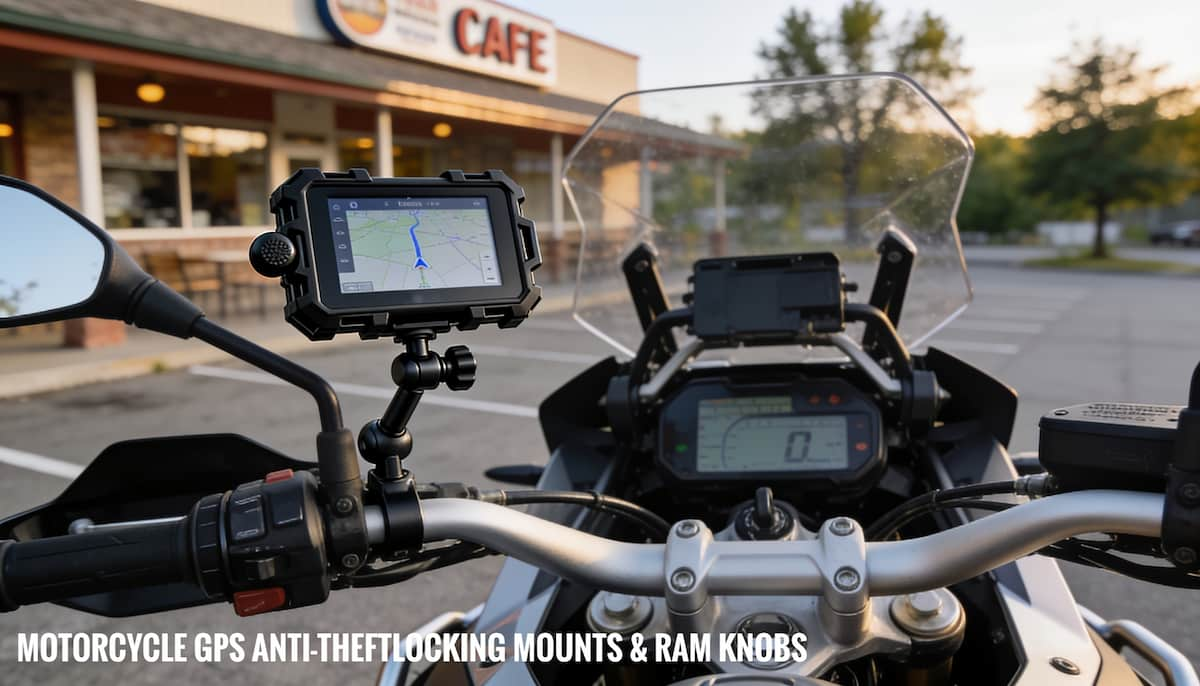
Because Garmin removed the built-in cradle security screw on the Zumo XT, Zumo XT2, and Zumo XT3 generations, anyone walking past your parked motorcycle can press the top release button and lift the navigator out of its dock in two seconds. Even worse, if you leave the standard plastic wing knob on your RAM double-socket arm, an opportunistic thief can unscrew the arm by hand in five seconds, steal your entire mount and hardwired Garmin power cradle, and rip the 12V wiring out of your fairing. Our recommendations draw on 20 years of experience selling and evaluating GPS devices and mounting equipment, supported by product research and technical analysis.
Quick answer: The single most reliable way to prevent GPS theft is to unclip the navigator from its cradle and slip it into a protective carry case whenever your motorcycle is out of sight. To stop someone from unscrewing your RAM arm and hardwired power cradle while the GPS is removed, replace the standard hand-turn wing knob on your 1-inch B-size RAM arm with a RAM Pin-Lock security knob, a keyed RAM-KNOB3LU locking knob, or a compatible third-party 1/4-20 anti-theft security knob. For two-minute fuel stops where you want to leave the GPS on the bars, pair that locked RAM arm with a dedicated stainless-steel cradle lock, and hide an autonomous cellular tracker on the bike for whole-motorcycle recovery.
The Three Weak Points of a Motorcycle GPS Mount
Before spending money on locking hardware, inspect how your navigator is attached to the cockpit. Almost every dedicated motorcycle setup using a motorcycle GPS mount has three distinct vulnerability points, and locking only one of them leaves the other two wide open:
- The quick-release GPS cradle latch: Dedicated motorcycle navigators like the Garmin Zumo XT, Zumo XT2, and Zumo XT3 are designed for rapid one-handed removal. Pressing the top button releases the spring latch immediately. Unless you install an aftermarket locking plate that blocks that button from moving, the GPS unit itself is completely unsecured.
- The RAM double-socket arm knob: Most motorcycle GPS units connect to the handlebars using a 1-inch B-size RAM ball-and-socket system. Out of the box, the double-socket arm uses a large T-knob that tightens and loosens by hand. Even if you lock the GPS into an expensive metal cradle, a thief can simply spin the standard RAM wing knob counterclockwise three turns and walk away with the locked cradle, the GPS inside it, and the RAM arm.
- The AMPS cradle bolts and handlebar base: The powered cradle attaches to a four-hole AMPS ball plate (spaced 1.188 inches by 1.813 inches) using four M4 machine screws and nylon lock nuts. While a casual passerby will not carry a metric hex key and miniature wrench in their pocket, riders parking in high-risk urban areas often swap standard Phillips or hex screws for pin-in Torx security screws.
| Security Layer / Hardware | What It Protects | Best Use Case & Fitment |
|---|---|---|
| Unclipping the GPS + Carry Case | The GPS navigator itself | Best for meal stops, hotels, and parking out of sight; requires locking the RAM arm so the empty powered cradle is not stolen. |
| RAM 5-Pin Security Knob (RAP-S-KNOB3-5U) | 1-inch B-size RAM arm & hardwired GPS cradle | Replaces the hand-twist RAM wing knob with a low-profile security nut turned only by the removable 5-pin key knob (1/4-20 thread). |
| RAM Key-Locking Knob (RAM-KNOB3LU) | 1-inch B-size RAM arm & hardwired GPS cradle | Uses a metal key cylinder and corrosion-resistant brass 1/4-20 insert so the outer knob spins freely when locked. |
| Third-Party B-Size Anti-Theft Security Knob | 1-inch B-size RAM arm & hardwired GPS cradle | Budget-friendly aftermarket 1/4-20 security lock knob and key adapter for standard 1-inch B-size double-socket arms. |
| Garmin Zumo Cradle Locks (Touratech / ZumoLock / MotoPumps) | Garmin Zumo XT, XT2, or XT3 inside the dock | Blocks the top release latch during 5-minute gas or coffee stops; never leave a GPS locked on the bars overnight. |
| Monimoto 9 Hidden Motorcycle Tracker | The entire motorcycle (hidden recovery tracker) | Calls your phone within 60 seconds and transmits LTE-M location updates if your parked motorcycle is moved without the key fob. |
Rule #1: Remove the GPS Unit When Parking Out of Sight
No matter how stout your locking bracket looks, a motorcycle GPS has an exposed glass touchscreen sitting in the open air. A frustrated thief who cannot pry a locked GPS out of a metal cradle can crack the display in seconds just trying to force the latch. Because dedicated motorcycle navigators are engineered with weatherproof quick-release docks, the smartest habit you can build is popping the GPS off the mount whenever you walk away for a restaurant meal, a hike, or an overnight hotel stay.
On a current Garmin Zumo XT3 (as well as the Zumo XT and XT2), removing the device takes less than two seconds: press the top release button, tilt the top edge of the navigator forward, and lift the bottom tab clear of the cradle. The hardwired 12V power cable stays attached to the dock on your handlebars, so you never have to unplug miniature power connectors or untangle wires when packing the screen away.
To prevent keys, tools, or helmet hardware from scratching the screen once the unit is off the bike, keep a rigid zippered EVA storage pouch in your tank bag, tail bag, or jacket pocket. You can read our dedicated guide to choosing a motorcycle GPS carry case for exact sizing across 4.7-inch, 5.5-inch, and 6-inch navigators. Once the GPS is safely stowed in its case and locked inside a hard pannier or carried with you, snap the rubber weather cap over the exposed copper pogo pins on the empty Garmin cradle.
How to Lock Your RAM Mount Arm and Powered GPS Cradle
Taking the GPS screen into a diner solves half the problem, but it leaves your RAM double-socket arm, AMPS ball adapter, and hardwired Garmin powered cradle sitting unprotected on the handlebars. Replacement Garmin powered cradles and wiring harnesses are expensive and time-consuming to re-route beneath fuel tanks and fairings. If a passerby loosens your standard RAM wing knob, they can strip the entire mounting assembly off your handlebar U-bolt in seconds and either yank your power cable loose or cut it.
Standard 1-inch B-size double-socket arms (such as the short RAM-B-201U-A, medium RAM-B-201U, and long RAM-B-201U-C arms included with Garmin Zumo and TomTom Rider kits) all use a 1/4-20 center carriage bolt thread. Replacing the factory plastic wing nut with a locking security knob takes less than two minutes and stops casual hand removal cold. You can also compare the broader lineup of B-size and C-size socket arm locks in our cross-site RAM Mount lock options guide on MountGuys.
1. RAM Mounts 5-Pin Security Knob and Key (RAP-S-KNOB3-5U)
For riders who want a compact, jam-free factory solution, the RAM Pin-Lock Security Knob (RAP-S-KNOB3-5U) is the most weatherproof way to secure a 1-inch B-size socket arm. Instead of leaving a winged knob on the side of your mount, the Pin-Lock system threads a smooth, low-profile circular security nut onto the arm’s 1/4-20 bolt shaft. The outer housing of that security nut cannot be gripped by fingers or ordinary pliers, and the recessed face contains a proprietary five-pin pattern.
When you want to adjust your GPS viewing angle or remove the arm, you snap the included matching five-pin key knob over the security nut, turn it to tighten or loosen the ball joints, and pull the key knob off to store on your keyring or inside your tank bag. Because the Pin-Lock uses high-strength composite materials with no delicate metal key tumblers exposed to rain, road salt, or dust, it never seizes up after wet touring miles and adds almost no visual bulk to the cockpit.
2. RAM Key-Locking Knob with Brass Insert (RAM-KNOB3LU)
If you prefer turning a traditional metal key rather than carrying a separate patterned plastic key cap, RAM manufactures the RAM-KNOB3LU Key-Locking Knob for 1-inch B-size arms. Once you tighten the knob to clamp your GPS arm at the desired angle, turning the small metal key disengages the internal clutch mechanism. When locked, the outer shell spins freely in circles without loosening the internal 1/4-20 brass threads, and the knob stays in one piece on the arm at all times.
Important: When ordering a keyed RAM knob for a motorcycle, verify two critical part details. First, confirm your RAM ball diameter: motorcycle GPS mounts almost always use 1-inch B-size balls (which require a 1/4-20 thread knob like the RAP-S-KNOB3-5U or RAM-KNOB3LU), whereas heavy 1.5-inch C-size arms use a larger 5/16-18 thread knob that will not fit. Second, always select the RAM-KNOB3LU (which uses a corrosion-resistant brass 1/4-20 insert built for outdoor motorcycle and marine weather) rather than the RAM-KNOB3LSU (which uses a steel insert intended for indoor or enclosed-cab vehicles). Also remember never to apply liquid threadlocker (such as Loctite) near a plastic GPS cradle or composite knob, as anaerobic threadlockers chemically attack plastics and cause them to crack.
3. Third-Party B-Size Anti-Theft Security Knob (1/4-20 Thread)
If you want a simple, lower-cost alternative to OEM RAM locking hardware, or you are outfitting multiple B-size socket arms across a GPS cradle, an action camera mount, and a phone holder, a third-party 1-inch B-size anti-theft security knob threads onto the exact same 1/4-20 carriage bolt used by standard RAM double-socket arms. Like the pin-lock design, it replaces the hand-turn wing nut with a tamper-resistant security fastener that requires the matching key tool to loosen, preventing opportunistic thieves from spinning your mount off the handlebars by hand.
How to Install a RAM Security Knob in Two Minutes
- Support the GPS cradle: Hold the GPS cradle and double-socket arm with one hand so the assembly does not drop against your fuel tank or instrument cluster when the clamping tension comes off.
- Remove the factory wing knob: Spin the standard RAM T-knob counterclockwise until it threads completely off the end of the 1/4-20 carriage bolt, keeping the internal center spring between the two arm halves in place.
- Thread on the security knob: Place the Pin-Lock security nut (with its key cap engaged), the RAM-KNOB3LU keyed knob, or your third-party 1/4-20 security knob onto the exposed threads and turn it clockwise a few turns until it catches smoothly.
- Set your viewing angle and lock: Sit on the motorcycle in your normal riding posture, angle the GPS cradle to prevent motorcycle GPS sun glare, and tighten the security knob firmly. Remove the key cap or turn and pull the metal key, then tug the arm by hand to confirm that neither ball joint slips.
Garmin Zumo Locking Mounts for Fuel and Coffee Stops
Long-time Garmin riders often remember that older navigators like the Garmin Zumo 550 and Zumo 665 featured a built-in metal security screw on the cradle, and the TomTom Rider 400 and 550 offered an official locking dock kit. Starting with the Zumo 396 and continuing through the Garmin Zumo XT, Zumo XT2, and Zumo XT3, Garmin eliminated the factory cradle lock entirely. Out of the box, there is no key or screw holding a Zumo XT-series unit inside its powered dock.
If you frequently make two-minute fuel stops, toll-booth stops, or rest-area bathroom breaks where unclipping and stowing the GPS every time feels tedious, an aftermarket locking mount bracket prevents a walk-by thief from pressing the release button.
1. Under-Cradle Release-Button Locks (ZumoLock XT and MotoPumps)
The cleanest mechanical locks for the Garmin Zumo XT, Zumo XT2, and 6-inch Zumo XT3 sandwich a precision-bent stainless-steel or powder-coated aluminum plate directly between the back of the plastic Garmin powered cradle and your four-hole AMPS RAM ball plate. Products in this category include the Dutch-made ZumoLock XT and the US-machined MotoPumps Zumo XT / XT2 / XT3 Security Mount.
When the GPS is snapped into the cradle and you turn the small barrel key on the top lip of the bracket, a sliding metal tang moves directly underneath or behind the Garmin cradle’s push-button latch. With that tang engaged, the top release button is physically blocked from depressing, making it impossible to unclip the Zumo by hand without the key. Because the plate mounts using the standard four-hole AMPS pattern, it adds minimal thickness and works with both RAM ball bases and above-the-dash adventure crossbar mounts.
2. Full-Cradle Locking Enclosures (Touratech and Wunderlich)
Adventure and touring riders who ride rough off-road trails often step up to a full laser-cut aluminum and stainless-steel locking cage, such as the Touratech Locking GPS Mount or the Wunderlich Lock System. Instead of merely blocking the top plastic push button, these enclosures surround the Garmin powered cradle with spring-loaded metal arms that close around the perimeter of the GPS body when you turn the key.
While a full Touratech or Wunderlich cage adds extra weight and depth to your handlebar or upper crossbar setup, it provides two advantages: it reinforces the plastic Garmin cradle over washboard gravel roads, and its visible metal key lock immediately signals to casual thieves that the navigator cannot be snatched off the bike. Just be sure to select the exact cage built for your generation, as the 5.5-inch Zumo XT, the 6-inch Zumo XT2 / 6-inch XT3, and the compact 4.7-inch Zumo XT3 do not share the same outer case dimensions.
3. Why You Should Avoid Cheap Generic Zumo Cradle Lock Plates
While third-party 1/4-20 security knobs work well on standard RAM arms, you should be much more selective when buying an under-cradle lock plate that bolts directly to your plastic Garmin Zumo power dock. Many unbranded stamped-metal Zumo cradle brackets suffer from uneven hole tolerances that warp the plastic Garmin cradle when the four AMPS screws are tightened, causing the brass power pins to lose contact over bumps or preventing the release latch from clicking shut smoothly. For locking the Zumo cradle itself, stick with proven specialist plates or rely on a locked RAM arm plus quick removal into a carry case.
Software Deterrents: Garmin Pin Codes and Legacy Security Features
On older automotive and early motorcycle navigators, Garmin offered a software feature called Garmin Lock, which required the owner to enter a four-digit PIN code or carry the device to a pre-selected physical GPS security location before the map screen would unlock. While a software PIN never stopped a thief on the street from stealing the hardware first and discovering the lock screen later, it kept personal home addresses and saved waypoints private.
Modern Garmin Zumo XT, XT2, and XT3 navigators no longer include the old Garmin Lock menu. Because thieves cannot tell whether a GPS has software protection until after they have already ripped it off your handlebars, software settings should be treated strictly as data-privacy measures rather than physical theft deterrents. A simple privacy habit that every touring rider should use on any GPS is saving your home address under a nearby intersection or landmark rather than labeling your exact driveway as “Home,” especially if you also keep garage-door opener remotes or house keys on the motorcycle.
Handlebar Navigator vs. Hidden Motorcycle GPS Tracker
Riders researching motorcycle GPS anti-theft equipment often confuse two completely different categories of hardware: securing a handlebar navigation screen versus hiding a recovery tracker inside the motorcycle chassis.
A handlebar navigator like the 6-inch Garmin Zumo XT3 is a visible cockpit computer built for turn-by-turn street and off-road routing, GPX track following, and helmet audio control. It has no built-in cellular modem and cannot broadcast its location to your phone if a thief steals your motorcycle or walks off with the screen.
If your goal is recovering the motorcycle itself if thieves lift the entire bike into a van, you need a hidden, self-powered cellular or satellite tracker such as the Monimoto 9. Unlike a handlebar GPS, the compact Monimoto 9 hides out of sight beneath your bodywork or seat, runs on its own internal rechargeable battery so cutting the motorcycle’s 12V battery will not disable it, and pairs automatically with a wireless key fob in your riding jacket.
If the motorcycle moves while your key fob is away, the tracker dials your phone directly within 60 seconds and streams location coordinates to the companion app via an embedded eSIM (which requires an annual cellular subscription after the initial trial period). You can compare the top recovery systems in our complete motorcycle GPS trackers guide.
Complete Cockpit Security Checklist for Touring Stops
Protecting your navigation setup works best when it is part of a quick, automatic parking routine that secures all of your exposed gear at once. Just as we recommend locking your helmet to the frame rather than leaving it hanging over a mirror in our motorcycle helmet theft deterrence guide, follow this three-tier routine based on how long you plan to leave the bike:
- Two-minute fuel or restroom stop (bike within sight): Keep a RAM security knob installed permanently on your double-socket arm, engage your Zumo cradle lock (or pop the GPS into your tank bag if you do not run a cradle lock), and take your ignition key with you.
- Restaurant meal, shopping stop, or trailhead parking (15 minutes to 4 hours): Press the top release latch, remove the GPS navigator from the cradle, snap the weather cover over the powered cradle pins, and place the GPS inside a padded carry case in your jacket pocket or locked hard luggage.
- Overnight hotel or street parking: Always bring the GPS unit and tank bag inside your hotel room for the night. Leave only the empty powered cradle on the bike secured by your locking RAM knob, park in a well-lit area in view of security cameras, and rely on a hidden tracker and heavy disc or chain lock to protect the motorcycle itself.
Frequently Asked Questions
Does the Garmin Zumo XT3 or XT2 come with a locking mount in the box?
No. Neither the Garmin Zumo XT3, the Zumo XT2, nor the original Zumo XT includes a key lock or security screw on the factory motorcycle cradle, and the bundled RAM double-socket arm comes with a standard hand-turn wing knob. To secure the mount against hand removal, you need to add a 1-inch B-size locking knob (such as the RAP-S-KNOB3-5U, RAM-KNOB3LU, or a compatible 1/4-20 anti-theft knob) and either unclip the GPS when parked or add an aftermarket cradle lock.
What is the difference between the RAM Pin-Lock (RAP-S-KNOB3-5U) and Key-Lock (RAM-KNOB3LU)?
Both fit standard 1-inch B-size RAM double-socket arms with a 1/4-20 center bolt thread. The RAP-S-KNOB3-5U Pin-Lock leaves a low-profile circular nut on the arm and removes the outer turning handle completely (you carry the 5-pin plastic key knob in your pocket or tank bag), so there is no metal lock cylinder exposed to rain or dust. The RAM-KNOB3LU Key-Lock stays attached as a full-size knob on the arm and uses a metal key cylinder with a brass insert that disengages the knob so it spins freely when locked.
Will a Touratech or ZumoLock for the 6-inch Zumo XT2 fit the 6-inch Zumo XT3?
Because the 6-inch Garmin Zumo XT2 and the 6-inch Garmin Zumo XT3 share the same two-pin powered motorcycle cradle and 6-inch outer chassis profile, under-cradle button locks and locking cages built for the 6-inch Zumo XT2 generally fit the 6-inch Zumo XT3. However, they will not fit the smaller 4.7-inch Zumo XT3 or the older 5.5-inch original Zumo XT, which use different cradle and housing dimensions.
Can I track my Garmin Zumo GPS if someone steals it off my handlebars?
No. A Garmin Zumo navigator is a GPS receiver, not a cellular transmitter. Once a thief unclips a Zumo from your handlebars, the unit has no way to transmit its coordinates back to you over cellular networks. Tracking a stolen motorcycle requires a dedicated cellular or satellite recovery unit with its own SIM card and internal battery.
Bottom Line
Effective motorcycle GPS anti-theft protection comes down to removing easy opportunities. Install a 1-inch B-size locking knob (whether you choose the removable-key RAM Pin-Lock RAP-S-KNOB3-5U, the metal-keyed RAM-KNOB3LU, or a budget-friendly third-party 1/4-20 security knob) on your socket arm once, and you never have to worry about someone casually unscrewing your RAM arm and hardwired Garmin cradle in a parking lot. For brief fuel stops, an aftermarket cradle lock adds convenient peace of mind, while taking two seconds to unclip your navigator and drop it into a protective carry case remains the smart, foolproof choice whenever you park out of sight.