Choosing the best motorcycle dash cam comes down to one critical difference: unlike a battery-powered helmet action camera that you have to charge and switch on before every ride, a dedicated motorcycle dashcam is a permanently wired, dual-channel (front and rear) accident-evidence recorder. Connected directly to your motorcycle’s 12V battery and switched ignition circuit, a hardwired motorcycle dash cam front and rear system boots up automatically the second you turn the key, loops continuous video onto a high-endurance microSD card, locks collision clips via a 3-axis G-sensor, and stamps your live GPS speed and route coordinates onto the video. Our recommendations draw on 20 years of experience selling and evaluating GPS devices and mounting equipment, supported by product research and technical analysis.
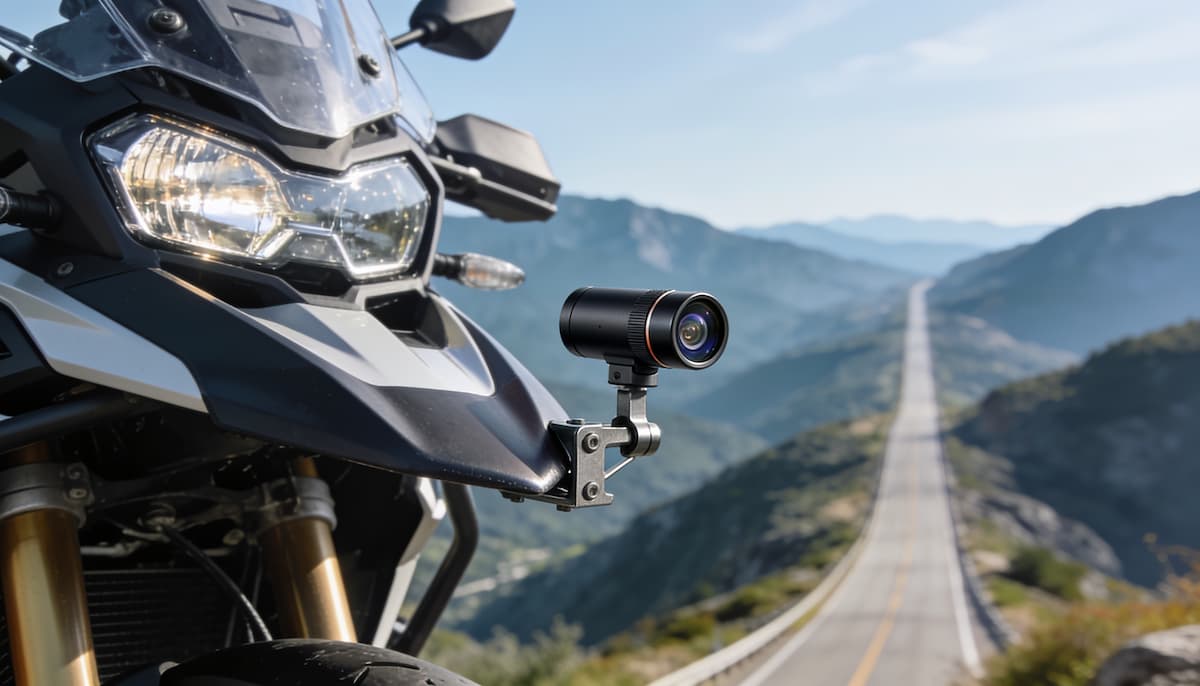
Whether you want a discreet under-seat “black box” DVR with hidden front and rear bullet lenses or an all-in-one handlebar display that combines a motorcycle camera front and rear with wireless Apple CarPlay, Android Auto, and blind-spot alerts, this guide compares the top weatherproof systems available today.
Quick answer: For maximum front license-plate clarity from a hidden under-seat recorder, the Vantrue F1 (Falcon 1) is our top pick, pairing a 4K Ultra HD front Sony STARVIS camera and 1080p rear camera with IP67 full-body waterproofing and a heat-proof supercapacitor. If you want a handlebar display that combines front and rear 1080p HDR dash cams with wireless Apple CarPlay, Android Auto, and camera-based AI blind-spot warnings, choose the 5-inch CHIGEE AIO-5 EVO. For a dependable mid-priced 1080p under-seat system with included GPS logging, choose the VIOFO MT1, or pick the VSYSTO D6L for an entry-level dual-1080p recorder.
Best Motorcycle Dash Cam Front and Rear Systems Compared
The table below compares verified hardware specifications across our top hardwired dual-channel dashcams for motorcycles and our recommended high-endurance microSD card. If you are shopping for removable helmet chin-mount or 360 cameras instead, see our best motorcycle action camera guide.
| Model | Front & Rear Resolution | Form Factor | Weather Rating & GPS | Amazon Link |
|---|---|---|---|---|
| Vantrue F1 (Falcon 1) | 4K Front (2160p) + 1080p Rear at 30 fps (Sony STARVIS) | Hidden screenless supercapacitor DVR + wired remote | IP67 waterproof, built-in GPS, 5 GHz Wi-Fi | View on Amazon → |
| CHIGEE AIO-5 EVO | 1080p Front + 1080p Rear HDR with EIS & AI Blind Spot | 5.0-inch 1,200-nit handlebar CarPlay/Android Auto screen | IP69K washdown rated, GPS & Wi-Fi included | View on Amazon → |
| VIOFO MT1 | 1080p Front + 1080p Rear at 30 fps (Sony Exmor R STARVIS) | Compact under-seat supercapacitor DVR + bar remote | IP66 weather resistant, external GPS, Wi-Fi | View on Amazon → |
| VSYSTO D6L | 1080p Front + 1080p Rear at 30 fps (130° Starlight lenses) | Mini under-seat DVR + wired handlebar controller | IP67 lenses (IP65 under-seat host), built-in Wi-Fi | View on Amazon → |
| SanDisk 128GB High Endurance | Supports 4K UHD & Dual 1080p/2K (U3, V30, Class 10) | High-Endurance microSDXC Card (SDSQQNR-128G) | Rated up to 10,000 hrs continuous rewrite | View on Amazon → |
1. Vantrue F1 (Falcon 1): Best 4K Front and Rear Motorcycle Dash Cam
When reviewing accident or hit-and-run footage, front resolution determines how far down the road you can freeze a video frame and read a vehicle’s license plate number. While most dashcams for motorcycles cap front recording at 1080p or 1440p, the Vantrue F1 (Falcon 1) pairs an 8-megapixel Sony STARVIS sensor in the front bullet lens for true 4K Ultra HD (3840 x 2160 at 30 fps) front recording with a 1080p Full HD (1920 x 1080 at 30 fps) rear camera, both covering a wide 160-degree field of view.
Designed for riders who already have a dedicated motorcycle GPS navigator on their handlebars and want zero extra screen clutter, the Vantrue F1 uses a screenless, IP67 full-body waterproof main DVR unit that installs under your seat or inside a fairing pocket. Instead of a lithium-ion internal battery that can swell under a hot motorcycle saddle in July, the Vantrue F1 uses an automotive-grade supercapacitor engineered to survive extreme temperature swings while providing enough reserve charge to safely close and save your final video segment the instant you turn off the key.
The Vantrue F1 ships with a wired handlebar remote controller featuring a built-in microphone and physical file-lock button, plus spoken voice prompts from the main unit that alert you if a memory card error occurs. Its built-in GPS module stamps live speed and coordinates onto the video and generates exportable trip mileage and elevation reports inside the Vantrue smartphone app over fast 5 GHz Wi-Fi (supporting Over-The-Air firmware updates and microSD cards up to 512 GB).
Best for: Touring, commuter, and adventure riders who want maximum 4K front license-plate clarity, supercapacitor heat durability, and a hidden under-seat installation.
2. CHIGEE AIO-5 EVO: Best All-in-One Motorcycle Dashcam + CarPlay Display
If you want to upgrade your cockpit navigation and install a front and rear camera for motorcycle use at the same time without wiring two separate boxes, the CHIGEE AIO-5 EVO combines a 5.0-inch 1,200-nit wireless Apple CarPlay and Android Auto display with dual hardwired 1080p HDR cameras right in the retail box (see our best motorcycle CarPlay and Android Auto displays guide for a full comparison of CHIGEE’s lineup, including the larger 6-inch AIO-6 series).
Unlike under-seat black boxes where you can only check camera alignment by opening a smartphone app over Wi-Fi, the CHIGEE AIO-5 EVO lets you view a live rear-view mirror feed or split-screen camera preview directly on its IP69K-rated handlebar touchscreen while riding. Even better, the AIO-5 EVO uses its rear 150-degree wide-angle Sony STARVIS camera and an onboard processor to run camera-based AI Blind Spot Detection (BSD): when a car or motorcycle approaches rapidly in your left or right rear blind spot, the edges of the handlebar display flash bright orange and red warning indicators in your peripheral vision.
Both included cameras record 1080p Full HD footage with High Dynamic Range (HDR) and electronic stabilization directly onto a microSD card inserted into the display (up to 256 GB, U3/V30 speed class required), eliminating the need to find room under a cramped sportbike or naked-bike seat for a separate DVR box. You also get an external GPS module for speed and route overlays, 24-hour parking impact monitoring, and compatibility with optional external Bluetooth motorcycle TPMS tire pressure sensors.
Best for: Riders who want wireless CarPlay/Android Auto navigation, live rear-view camera preview, and AI blind-spot warnings integrated with their front and rear dash cameras.
3. VIOFO MT1: Best Mid-Range 1080p Supercapacitor System With GPS
VIOFO is one of the most trusted engineering brands in automotive dash cameras, and the VIOFO MT1 brings that same supercapacitor reliability and dual Sony Exmor R STARVIS low-light sensors to motorcycles at a lower cost than 4K systems. Both the front and rear IP66 weather-resistant metal bullet cameras record 1080p at 30 fps across a wide 170-degree diagonal field of view, feeding into a slim under-seat DVR unit.
Like the Vantrue F1, the VIOFO MT1 uses a heat-resistant supercapacitor rather than a lithium battery, paired with a 3-wire power harness (battery positive, battery negative, and switched ACC trigger) that starts and stops recording automatically with your ignition key. The included handlebar remote features status LEDs, a built-in microphone, a Wi-Fi toggle button, and a manual emergency-lock button, while the included external GPS module logs speed, time, and route coordinates viewable in the VIOFO smartphone app. VIOFO even includes a 32 GB microSD card and metal/plastic camera brackets in the box, supporting expansion up to 256 GB.
Best for: Riders who want a complete, name-brand 1080p front-and-rear under-seat dash cam with Sony STARVIS night vision, included GPS logging, and supercapacitor durability.
4. VSYSTO D6L: Best Budget Dual-1080p Motorcycle Dash Cam
If you are shopping on a strict budget and searching for a proven VSYSTO motorcycle dash cam, the VSYSTO D6L is the company’s most established entry-level dual-1080p kit. It pairs two compact IP67 waterproof 1080p Starlight night-vision bullet lenses (covering a 130-degree field of view) with a tiny under-seat DVR host measuring just 2.44 x 2.28 x 0.78 inches and a wired handlebar emergency-lock button.
The VSYSTO D6L wires into your 12V battery and switched ignition lead via its included ACC power module (stepping 12V bike power down to 5V/2A) or can run temporarily off a 5V USB power source, automatically looping 1-, 2-, 3-, or 5-minute video clips onto a microSD card up to 256 GB. Built-in Wi-Fi lets you preview live camera angles and download saved clips through the VSYSTO smartphone app without pulling the memory card. Keep two budget trade-offs in mind compared to the VIOFO MT1 and Vantrue F1: the base D6L does not include a GPS speed-logging antenna in the box, and the main DVR unit is rated IP65 splash-resistant rather than submersible, so always mount the host module in a dry spot under your seat.
Best for: Commuters and budget-conscious riders who want a simple, low-cost front and rear 1080p loop recorder that turns on and off automatically with the ignition key.
What About the INNOVV K6 and INNOVV K7 Motorcycle Dash Cams?
If you spend time on touring and adventure forums, you will frequently see riders ask about an INNOVV motorcycle dash cam, specifically the compact INNOVV K6 and the flagship INNOVV K7. Both are well-engineered CNC-machined aluminum systems, and understanding how they differ helps clarify whether you should order one through a powersports dealer or choose a Vantrue F1 or CHIGEE unit instead:
- INNOVV K6 (DVR Built Into the Front Lens for Zero Under-Seat Space): The standout engineering trick of the INNOVV K6 (2K 1440p front + 1080p rear at 30 fps) is that it eliminates the separate under-seat DVR box entirely, building the recording electronics and microSD slot directly into the slightly larger front camera barrel (80.5 mm x 28 mm). That makes the K6 popular on modern sportbikes and BMW XR models that have zero room under the seat. However, the K6 lacks built-in GPS speed logging and requires unscrewing the rear cap of the front camera barrel whenever you want to physically remove the microSD card.
- INNOVV K7 (Under-Seat Dual 2K With EIS and 10 Hz GPS): The INNOVV K7 steps up to symmetrical 2K + 2K recording at 30 fps (or 1080p + 1080p at 60 fps) with Electronic Image Stabilization (EIS), an external 10 Hz GPS receiver (similar to the Garmin Zumo XT2), and an aluminum under-seat DVR box. Because INNOVV primarily distributes the K6 and K7 through specialty powersports retailers rather than maintaining permanent US Amazon Prime stock, riders who want fast Prime shipping and higher 4K front resolution typically choose the Vantrue F1 (Falcon 1) above.
Why You Must Use a High-Endurance U3/V30 microSD Card
The number-one cause of corrupted video files, random DVR reboots, and missed accident clips when running a dash cam on motorcycle trips is using a cheap desktop or standard consumer microSD card. Because a dual-channel motorcycle dashcam writes two simultaneous high-bitrate video streams continuously while overwriting old segments hundreds of times a month in high heat, standard flash memory cells wear out and lock into read-only failure mode.
Important memory card rule: Every dual-channel 4K, 2K, and 1080p system above requires a UHS Speed Class 3 (U3) / Video Speed Class 30 (V30) card rated specifically for continuous loop overwriting. Always format a new card inside the dash cam’s smartphone app or on-screen menu before your first ride, and reformat it once a month to clear fragmented locked files. For a deeper look at card speed classes and file systems, see our microSD card speed and formatting guide.
The SanDisk 128GB High Endurance Video microSDXC Card (SDSQQNR-128G-GN6IA) is purpose-built for dash cams and continuous loop recording, carrying Class 10, U3, and V30 speed ratings (up to 100 MB/s read and 40 MB/s write speeds) and an endurance rating of up to 10,000 hours of continuous Full HD recording across operating temperatures from -13°F to 185°F (-25°C to 85°C).
Hardwired 12V Installation and Camera Placement Tips
Installing a dual-channel motorcycle dash cam takes about 60 to 90 minutes of careful cable routing. Following four proven mechanical and electrical practices will prevent rolling-shutter jello distortion and dead motorcycle batteries:
- Mount Lenses to Sprung Frame/Fairing Structure, Not Unsprung Forks: Never clamp a front dash cam lens to your lower front fork tubes or front fender, where raw road impacts will overwhelm even the best electronic stabilization. Instead, mount the front lens underneath the upper headlight beak, inside the upper fairing stay, or on a rigid bracket attached to your motorcycle GPS mount crossbar (including BMW Motorrad GPS mount upper crossbars), and mount the rear lens to the license-plate bracket or tail rack.
- Understand 3-Wire Power Harnesses (B+, GND, and Switched ACC): Dedicated dash cams like the Vantrue F1, CHIGEE AIO-5 EVO, VIOFO MT1, and VSYSTO D6L use a three-wire harness: the Red wire connects to constant 12V battery positive (to power 24-hour impact parking mode and allow graceful file closing), the Black wire connects to battery negative/ground, and the Yellow (or Blue) ACC trigger wire taps into a switched 12V circuit (such as a taillight lead, accessory fuse box, or CAN-bus controller) that only receives voltage when the ignition key is on. See our motorcycle 12V power and wiring guide for safe circuit-tapping methods.
- Leave Slack Loops at the Steering Head: When routing the front camera cable and handlebar remote wire back toward the under-seat DVR, secure the loom along your factory clutch or main wiring harness and check full left-to-right steering lock so the threaded waterproof aviation connectors are never pulled tight.
- Disable Parking Mode During Winter Storage: Even though modern dash cam power modules cut off parking surveillance automatically if battery voltage drops below roughly 11.8V to 12.0V, leaving parking mode active for weeks in an unheated garage will slowly cycle down a small motorcycle battery. Either unplug the inline fuse or turn off Parking Mode in the smartphone app when storing the bike.
Frequently Asked Questions
Is a hardwired motorcycle dash cam better than a helmet action camera?
They serve different purposes. A helmet-mounted action camera like a GoPro or DJI Osmo Action records wherever you turn your head and captures dramatic stabilization for sharing rides, but its battery dies in 90 to 120 minutes and you have to remember to charge and mount it every trip. A hardwired motorcycle dash cam records both front and rear views simultaneously, runs continuously off 12V bike power without battery swaps, and turns on automatically every time you start the engine. Many touring riders run a hidden dash cam for 24/7 insurance protection alongside a helmet camera for scenic roads.
Where does the DVR box go on a motorcycle with no under-seat space?
Most under-seat DVR boxes (like the VIOFO MT1 and VSYSTO D6L) are smaller than a deck of cards and can be secured with 3M Dual Lock inside a side fairing panel, behind the headlight cowl, inside a tail hump, or inside a locked top case. Alternatively, choosing a handlebar-mounted system like the CHIGEE AIO-5 EVO eliminates the under-seat DVR box completely because the recording hardware and microSD card slot live inside the 5-inch handlebar display.
Does a motorcycle dash cam drain the battery when parked?
When wired properly with the yellow ACC trigger wire connected to a switched 12V ignition source, the dash cam shuts down automatically within seconds of turning off the key and draws almost zero standby current. If you enable 24-hour G-sensor Parking Mode, the camera sleeps in a low-power state and only wakes up for 30 seconds if someone bumps the bike, while a built-in low-voltage protection circuit shuts the module off completely if your battery dips below its safe starting threshold.
Bottom Line: Which Motorcycle Dash Cam Should You Buy?
To pick the best motorcycle dash cam for your cockpit, match the architecture to your riding style and budget:
- For maximum 4K front license-plate detail in a hidden under-seat setup: Choose the Vantrue F1 (Falcon 1), which pairs a 4K front Sony STARVIS sensor and 1080p rear camera with IP67 waterproofing, 5 GHz Wi-Fi, GPS logging, and a heat-proof supercapacitor.
- For an all-in-one CarPlay screen + front/rear dash cam + blind-spot monitor: Choose the 5-inch CHIGEE AIO-5 EVO.
- For a reliable mid-priced 1080p under-seat system with GPS: Choose the VIOFO MT1.
- For an entry-level budget 1080p dual recorder: Choose the VSYSTO D6L, and pair whichever system you buy with a SanDisk 128GB High Endurance U3/V30 microSDXC card.